Answers · Costs
How Much Does It Cost to Make an AI Movie?
Published November 6, 2026

What people actually spent
The budgets people post for solo AI films are surprisingly consistent: a five-minute film at around five hundred dollars, a twelve-minute film at around twelve hundred. The question of what a film costs comes up in 83 posts in the community corpus. The most useful of those reports came with an admission — the maker of the twelve-minute film reckoned half the money was wasted, and said where it went:
The expensive part wasn't really the final 12 minutes. It was everything that never made it into those 12 minutes
That comes from a post in r/aifilmmaking that repays a full read, because every lesson in it is about attempts rather than prices: draft at low resolution first, test complicated compositions as still images, and expect shots with three or more characters to eat generation after generation. Prices and credits are the largest money topic in the community corpus, with about 18,000 posts carrying the label.
The arithmetic behind any budget
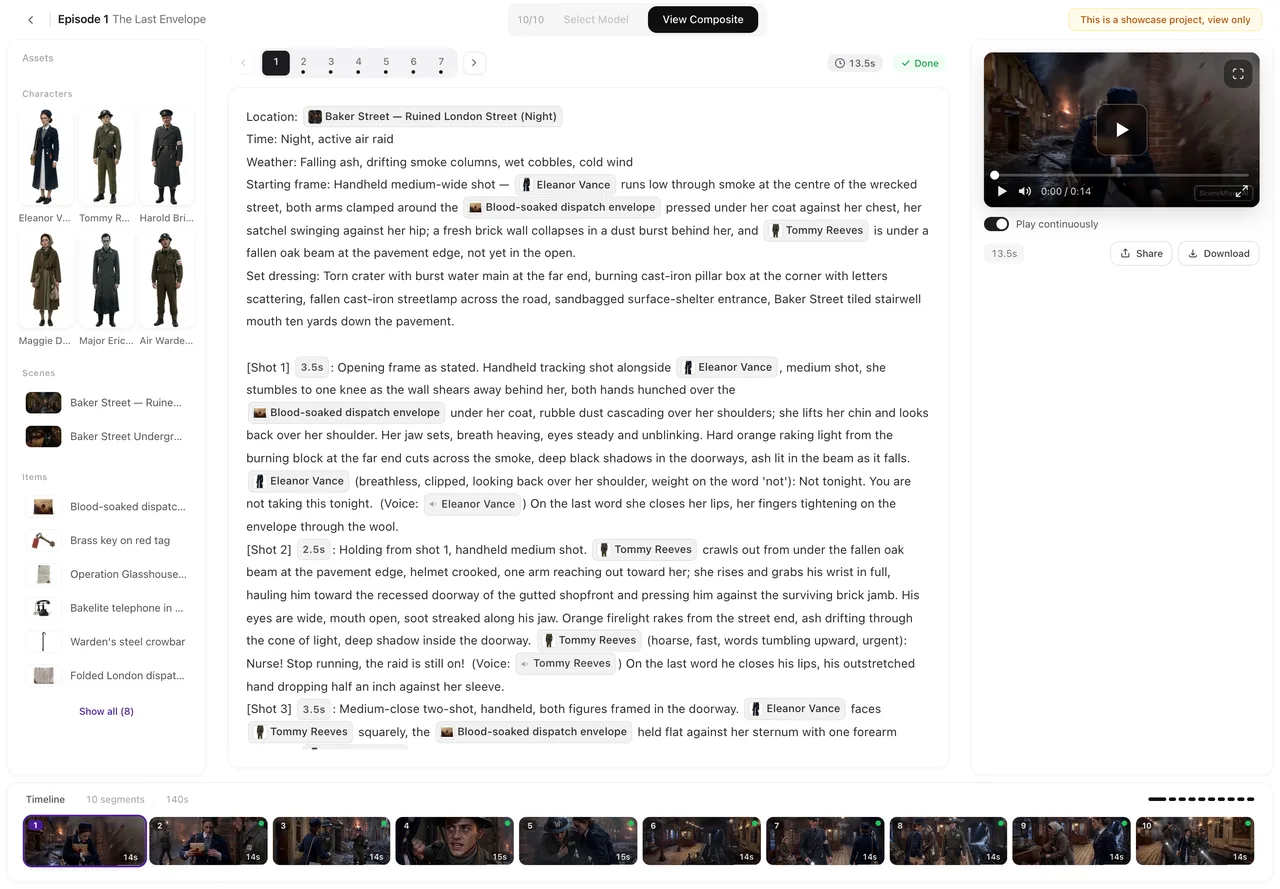
Video is priced by the second of delivered output. On SceneMixer the default rate is 10 credits per second — about $0.06 at the lowest credit price — and the most expensive tier runs closer to $0.47 per second. Joining the segments into a finished episode adds 1 credit per second. So a sixty-second episode at the default tier is 660 credits, about $4.11, before any retakes.
Everything else is small by comparison. Reading a script is priced by length and paid once per project; character and location images are a few credits each, with free ones on a new account; the storyboard is a credit per few hundred characters. Editing, previewing and switching between versions you already have cost nothing.
What a finished episode cost on SceneMixer
List prices are one thing; here is what people actually spent, measured on the site over the 30 days to November 6, 2026 across 302 finished episodes. The median episode used 1,027 credits for the video and compositing behind its final takes — about $6.39. Half of all episodes fell between 572 and 1,910 credits, roughly $3.56 to $11.89.
Scale that up the way a film is planned. A five-minute story is about four episodes of median length, so on these figures its finished takes come to a few thousand credits — tens of dollars, not hundreds. The gap between that and the community budgets above is the part this page is really about: the reported films were made by stitching separate tools together, regenerating whole sequences when a face drifted, and paying for the experiments that taught the maker how to do it. Some of that learning cost is unavoidable on any tool; most of the drift cost is not.
Two things push a real episode above the sixty-second list figure. The median episode ran 80 seconds, not sixty, and many people pick a higher-quality tier than the default. The figure counts the takes that ended up in the episode; earlier takes that were replaced are on top, which is exactly the multiplier the twelve-minute film describes.
How to keep the bill near the arithmetic
- Fix the shot in words before you render. Editing the storyboard is free, and a wrong shot caught as text costs nothing.
- Get the character sheets right first. Drifting faces are a common reason for retakes, and a sheet costs a fraction of a segment.
- Draft at the cheaper tier and move up only the shots that survive.
- Regenerate one segment, not the episode. A fix touches only the segment you change.
- Use the free allowance on the cheap steps — that is where you find out whether the expensive step is worth running.
The answer on why AI video generation is so expensive goes deeper on the retry multiplier, and where credits go in one episode lists every charge.
Limitations of these cost figures
- The site figures are one month of finished episodes on SceneMixer, refreshed monthly. They count video and compositing for the final takes only, not script reads, images or replaced takes.
- Money figures use the lowest credit price; buying smaller packs or using a subscription allowance changes the effective rate.
- The community budgets are individual reports from public threads, not an average.
- Post-production you do elsewhere — editing, music licensing, festival fees — is a separate budget.
FAQ
What does one finished episode cost on SceneMixer?
Over the last month the median finished episode used about a thousand credits of video and compositing, roughly six dollars at the lowest credit price; half of all episodes fell between about three and a half and twelve dollars.
Why do AI films cost so much more than the per-second price?
Because you pay for attempts, not for the take you keep. Every regenerated shot is the same seconds bought again, and complicated shots need more attempts.
Are failed generations charged?
On SceneMixer, failed generations aren't charged; in rare cases, support checks it and returns the credits.
What is free?
Editing the storyboard, previewing, switching versions and re-reading what you already have. New accounts also get free reference images, a free first-episode storyboard and a short free preview.
Related: how long an AI movie takes puts time next to the money, a worked micro-drama budget prices out a whole series, and the community counts follow the collection method.
Price your own episode first
Read your script and see the cost of every step on the button before anything is charged.
Sign up freePer-second video rates are on the pricing page with the same numbers.