Answers · Adaptation
How Do I Turn a Novel Into an AI Short Drama?
Published November 6, 2026

What a novel has that a screenplay does not
A screenplay is already written for the camera. A novel is not: it has inner monologue, time skips, a narrator who knows what everyone is thinking, and dozens of characters who must look the same in chapter one and chapter forty. That gap is why so many writers ask the question in the same words. A crime novelist with several ten-book series put the wish plainly:
I feel like it would be really cool to turn each book into a season of a TV show, something like 10 episodes
The interest is not small. Around 7,300 posts in the community corpus carry a story-adaptation label, and the adaptations that get attention are the ones where the writer stayed involved — a teaser in r/aivideos for a bestselling historical series was made with the author in the room the whole way. On SceneMixer you do not convert the novel into a script first. The novel is the input, and the first step is a read that does the conversion for you.
Step one: paste the chapter and let the read split it
On the home page, the Upload Script tab takes the text itself: paste it, or upload a TXT, DOCX or Markdown file. A chapter, a few chapters, or a whole short novel all go in the same way. The read then extracts the characters, the locations, the props and an episode structure, with each episode outlined around a conflict and an ending that pulls you into the next one.
Long books are handled differently from short ones. Past about 33,000 characters, the read switches to a two-step path built for long material: one pass returns the cast, places and props, and a second returns the episode skeleton. Each episode's full outline is then expanded only when you open that episode, so a sixty-episode book does not pay up front for sixty expansions you may never use. The read is priced by length — 4 credits per 3,333 characters — and is paid once for the whole project, not per episode.
If your book is longer than the upload limit, split it into volumes and run each as its own project. That is also the natural shape of a season.
How a chapter turns into episodes
The read makes the editing decisions an adapter would make. A time skip becomes an episode boundary or an on-screen caption. A paragraph describing a character's face turns into that character's sheet; a paragraph describing a room turns into a location image. Inner monologue either becomes a voice-over line or is dropped where the picture already says it.
What comes out is shorter than most people expect. On SceneMixer the median finished episode over the last month ran 80 seconds across 7 segments — short-drama length, not television length. A chapter of a few thousand words usually yields several of those. And people do keep going past the pilot: of the 151 projects that finished at least one episode in that window, 43 (28%) finished two or more.
Approve the cast before anything moves
The step that decides whether episode five still looks like episode one happens before any video is made. Every character the read found gets a full-body reference sheet, and every location gets an image. Those images are the cast and the sets. Face and body crops from each sheet are passed into every video segment that character appears in, so the same face, hair and signature costume carry through the whole series.
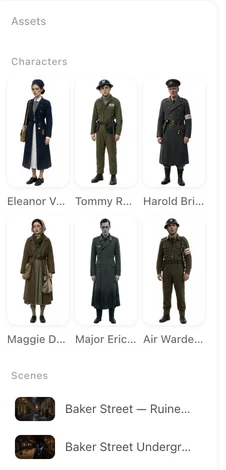
This is where to spend attention. Read every sheet against the book: the age, the build, the scar the narrator mentions twice. A new account has 15 free reference images to spend across its projects, and regenerating a sheet you do not like is far cheaper than regenerating the video it would have ruined. The answer on why characters look different in every shot explains what happens when this step is skipped.
Storyboard one episode, then render it
Each episode is written as a storyboard: short segments with shot-by-shot text, durations and dialogue. Editing that text is free — no model is called — so fix the adaptation here, in words, while it costs nothing. The first project's first episode storyboard is free; after that a storyboard is 1 credit per 333 characters of that episode's share of the book.
Then render. Segments run in parallel, so an episode is not a day's work. Measured on the site over the last month, the median time from the first segment starting to the finished, composited episode was 24 minutes, and the median finished episode used 1,027 credits of video and compositing — about $6.39 at the lowest credit price. Half of all episodes fell between 572 and 1,910 credits; the spread is mostly runtime and the quality tier people chose.
Render one episode, watch it on the screen your audience will use, and only then plan the season. The novel to video page has the full pipeline, and the four ways to start a project explains when a chapter is better than a one-line idea.
Limitations of adapting a novel this way
- Adapt only what you have the right to adapt. The read does not check who owns a book; that question is yours.
- Very long books need splitting. Run each volume as its own project; the cast can be reused so faces match across them.
- Inner life is the hardest thing to film. A chapter that is mostly thought will come back short, with the thinking turned into voice-over or cut. If that matters, add a scene in the storyboard where the character says it to someone.
- The read can merge two minor characters or miss a location that is only mentioned once. Check the cast list before you generate sheets; adding a character is free text work.
- The site figures are a snapshot of one month on SceneMixer, refreshed monthly; the community count is a keyword approximation over a fixed set of public threads.
FAQ
Do I need to write a screenplay before I start?
No. Paste the novel itself. The read turns it into a cast, places and an episode list, and each episode becomes a storyboard you can edit as text before anything is rendered.
How long can the novel be?
Past about 33,000 characters the read switches to a two-step path built for long books, and each episode's outline is expanded when you open it. Beyond the upload limit, split the book into volumes and run each as a project.
How much does the first episode cost?
A new account gets free reference images, a free episode-one storyboard on its first project and a short free preview. The finished episode itself is billed by the second of video; over the last month the median episode on SceneMixer used about a thousand credits.
Will the characters look the same in later episodes?
That is what the sheets are for. Each character's sheet is passed into every segment they appear in, so the face and costume carry across episodes; check the sheets carefully before you render.
Next: the answer on keeping the same characters in every episode covers the series side, what you can feed in lists the formats and limits, and the community counts follow the collection method.
Paste your first chapter
Get the cast, the places and an episode list from your own book, then render the opening shot free.
Sign up freePer-second video rates are on the pricing page with the same numbers.