Answers · Writing
Can AI Write a Novel?
Published November 18, 2026

Length is the hard part
Writing a scene is easy for a language model. Writing a book is a different task, because a novel is a long chain of promises: a gun on the wall in chapter three, a lie that has to be found out by chapter twenty, a minor character whose eye colour cannot change. Models generate in windows, and what falls outside the window is guessed at. That is why AI drafts read well page by page and fall apart across chapters, with characters who forget what they learned and subplots that simply stop.
Many writers use AI on the other side of the book: the novel is theirs, and the model helps them do something with it. One post in r/aivideos is a good example:
I'm working on a movie for the novel I wrote, today was first tests with video
Adaptation is a large topic in its own right; about 7,300 posts in the community corpus are about adapting stories or scripts.
What AI is genuinely useful for in a novel
Outlining alternatives when a plot is stuck. Summarising your own chapters so you can see the shape of the book. Checking a timeline or a character list for contradictions. Suggesting a dozen names for a minor character. Reading a scene aloud so you hear its rhythm. None of these writes the book, and all of them save the kind of time that otherwise goes into rereading.
A workflow that uses AI without handing it the book
Keep a story bible outside the model: every character with age, look, what they know and when they learned it, plus a one-line summary of each chapter. Write or revise one chapter at a time, and paste the relevant parts of the bible in with it, so the model is reminded of what it cannot remember. Ask for problems rather than prose: where does this chapter contradict an earlier one, which scene could be cut, what does the reader not yet know. Read the whole book aloud before calling it finished; repeated phrasing and characters who all sound alike are easier to hear than to see. Above all, decide the ending yourself, early, and make every chapter earn it.
What stays the author's
The voice, the cuts and the ending. A novel is recognisable by its sentences, and a model's default sentences are everyone's sentences. Deciding what to leave out is the other half: drafts generated at length tend to explain too much and resolve too neatly. Many publishers and contests also ask whether AI was used, so keep a record of how you worked.
From your novel to a series
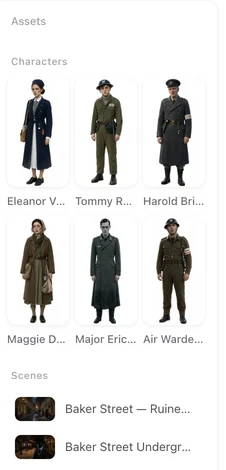
If the book is written, the next step people ask about is seeing it. SceneMixer takes a novel in Chinese or English, extracts the characters, scenes and an episode-by-episode structure, draws each character and place once, writes a storyboard for each episode and renders it segment by segment. The text you wrote decides what happens; the reading turns it into shots. A long book becomes a season rather than one video, and you can edit every storyboard as text before anything renders.
Can AI write novels that readers finish?
Occasionally, with heavy human revision. Fully generated books exist in large numbers, and most are noticed for the wrong reasons: repetitive phrasing, flat dialogue and endings that resolve nothing. The books that work treat the model as a tool inside the writing process rather than as the writer, which is also how most working authors describe their use of it.
Limitations of AI-written novels
- Continuity breaks over length: names, ages and timelines drift between chapters.
- Default prose is generic; the voice has to be revised in.
- Rules on disclosing AI use differ between publishers, stores and contests.
- SceneMixer adapts a novel into episodes; it does not draft the novel itself.
- The adaptation-topic count is a rule-based label over a fixed window of public posts.
FAQ
Can AI write novels that are good enough to publish?
A first draft, yes; a book that holds a reader usually needs heavy human revision. SceneMixer works the other way round, adapting a novel you wrote into episodes.
How long can an AI-written novel be?
As long as you ask for, chapter by chapter, but consistency weakens with length. Keep an outline and a character list beside it.
Can AI turn my novel into a video series?
Yes. SceneMixer reads a Chinese or English novel into characters, places and an episode structure, then renders each episode.
Is using AI to write a novel cheating?
It depends on the rules of where you publish; many ask you to disclose it. Using it for outlines and checks is common practice.
Related: whether AI can write a story, turning a novel into an AI short drama, how a text becomes a cast, and the collection method behind the count.
Bring your own book
Upload the novel you wrote; SceneMixer reads it into characters, places and episodes you can edit as text.
Sign up freePer-second video rates are on the pricing page with the same numbers.