Answers · Length
How Do I Make an AI Video Longer Than One Minute?
Published October 14, 2026

Why one minute is a wall, not a limit
A clip is short by nature: one generation call returns a handful of seconds, and asking the same call for three minutes gets you a refusal, not a film. The wall is in the generation, not in the story — so the way past it is structural. Here the build block is the segment: one request to the video model, running up to 15 seconds on Seedance 2.0, with the longer-take setting going further on the tiers that accept it. Past that ceiling, length stops being a bigger render and becomes more segments, planned together.
The community frames the same wall. A representative post from the corpus:
I've been looking for options to create videos for longer than one minute. So far, I haven't found any good ones.
About 5,900 posts in the corpus carry a length or extension label, and the single question about long-form video groups 390 near-identical posts. The demand is not for a single heroic render; it is for a way to build minutes out of parts without the seams showing.
How a longer cut is actually assembled
The script is divided into episodes, and each episode into segments of roughly fifteen seconds, chosen when you generate the storyboard: Standard 15s or the Long take 30s setting. Each segment is a generation call on its own, and each is built from numbered shots whose seconds add up to the segment total — so pacing is tuned by editing shot seconds, free, before anything is generated. One episode holds up to 60 segments, which is far more headroom than a one-minute video needs: across projects here the median episode is seven segments and the median segment fourteen seconds, a typical episode of about a hundred seconds of screen time.
When the segments exist, the composite joins their active versions in timeline order into one file, cut hard, at 1 credit per second of the finished episode. Nothing is re-rendered in the join, so it is quick and cheap, and it can be run again whenever a segment changes. The composite is the last mile of every length question on this site: minutes are segments that have been joined, not one long render.
Keeping the joins invisible
The seams are the real project. One segment is one generation call, and every extra segment restarts positions from a new first frame — which is exactly why length is built in long segments rather than many short ones: raise the pace by shortening shots inside a segment, not by slicing the segment into more calls.
Two things make the seams behave. The first is the carry: the next segment opens where the last one ended, so whoever was seated, wherever the hands were, that is the starting state for the next call. The second is the scene's spatial model — every scene gets an automatic three-dimensional model of the room, the furniture that matters and where each person is placed, and every shot of that scene is generated against it, so seats, doors and walls hold across the cuts whether they happen inside a segment or between segments. Write the storyboard the way you would describe a real room and both mechanisms have something to hold onto; write it vaguely and the joins inherit the vagueness.
What longer costs
The per-second rate does not change with length — a second is priced the same whether it is the first or the four-hundredth. What changes is the number of seconds billed, plus the one line that exists only because the video is long: compositing, at 1 credit per second of the finished episode. So the total is seconds times rate, twice over — once for the video, once for the assembly — and then the retake count multiplies the video half. Retakes are the variable that surprises people, and they are their own answer: why the retry count dominates the bill.
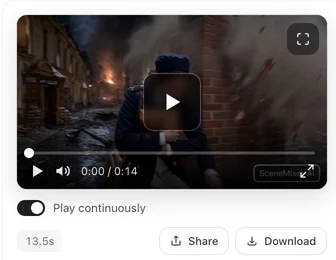
How long the community wants to go
Three counts describe the demand from three angles — the broad label, the single most-repeated long-form question, and the consistency question that rides along with every long project:
| Posts behind the length wall | Posts |
|---|---|
| Length-extension labels | 5,900 |
| The long-form question | 390 |
| Keeping a character locked | 140 |
The third row is the tell: the hard part of going long was never the minutes, it was keeping the person the same across them — an anchoring problem rather than a rendering one. The receipt is a maker's own account from the corpus:
I just finished my first 12-minute film, made alone with no team.
Twelve minutes is not one heroic generation; it is a stack of ordinary segments whose joins were planned, with the cast pinned once and reused. The quote comes from a production write-up in r/aifilmmaking.
When this does not apply
- A single beat does not get better with length. If your clip is one gesture or one line, one segment is the whole film; stretching it adds joins, not story.
- The composite cuts hard between segments — it is a join, not an editor. Fades, wipes and speed ramps are not part of it, so plan transitions inside shots rather than at the seams.
- There is no per-segment hide switch. To leave a segment out of the finished cut, delete it — which also removes its storyboard text — or rewrite it into a shot you want.
- These figures are the site's listed rates and measured medians from a fixed window, not a forecast for your script; retakes, tier choice and how many times you recomposite all move the real number.
FAQ
Can I generate a three-minute video in one call?
No. One call is one segment, capped at 15 seconds on Seedance 2.0 and thirty on the tiers built for long takes. Three minutes is a stack of segments joined by the composite — which the pipeline is designed for.
Does a longer video cost more per second?
No. The rate is per delivered second whatever the total. Two lines only exist because the video is long: the retries that missed, and the composite, which adds its own credit per second of the finished episode.
What happens at the joins between segments?
Each new segment opens where the previous one ended, and every shot is generated against the scene's spatial model, so positions, seats and walls carry over. If a join still reads wrong, regenerate that one segment — the storyboard text, not the whole episode, is what to fix first.
Can I change a segment after compositing?
Yes. The composite takes each segment's active version in timeline order and can be run again after any change; recompositing is a new composite at the same per-second rate. The old cut stays in its own record either way.
Two guides take this further: what the two segment lengths change in practice and what the composite joins are the mechanics, and the sibling answer on whether AI can make a full-length movie yet is this same arithmetic carried to ninety minutes. How the counts here are collected is described in the method note; the first quoted search comes from a discussion in r/generativeAI about one-minute limits.
Build minutes from parts
Upload a script; SceneMixer writes the episode, plans the segments, and joins the finished ones into a single cut.
Sign up freePer-second video and composite rates are on the pricing page with the same numbers.
Pricing·Novel to Video·Guides·Samples·Alternatives·Answers·Support·Privacy·Terms·Legal·Contact·Affiliate program·© 2026 SceneMixer