Answers · Voice
How Do I Keep a Character's Voice Consistent Across Episodes?
Published October 14, 2026

The three ways a character can carry a voice
Characters are matched from a preset voice library rather than designed from a text description, and you can upload your own sample for a character instead. Concretely there are three states a character can be in. The first is a voice written in words: age, weight and pace, taken from the script read, performed by the video model. That is where every character starts unless you do something, and it does a reasonable job — the description is what the model hears in place of a sample.
The second is a matched preset. Each voice in the library ships with a short sample you can play before choosing; the site proposes a match per character by gender, language and age, and you can re-match or pick a different one by hand from the selector. Matching is a free model call — it does not consume credits, and it is not blocked by your concurrency limit. The third is your own recording: upload a sample for a character and it becomes that character's voice reference for every segment they speak in, and later matching does not overwrite it.
One boundary to hold: the matched library and the upload path exist for voices you own or are licensed to use. The site's own compliance guidance treats likeness — face and voice alike — as something you must have the right to use before you publish, and the interface cannot check that a sample is yours: whoever presses upload carries the responsibility. So upload your own voice, or one you have permission to use, and treat anything else as a question for a lawyer rather than a workflow trick. The terms put the same weight on it.
Why the same voice survives a whole series
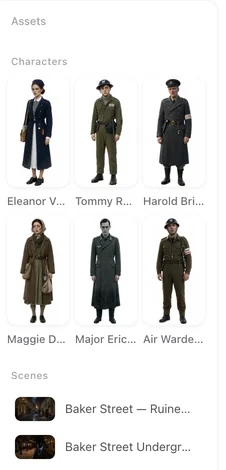
The voice, like the face, is a property of the character in the project. Whichever source is attached is used consistently: the same character speaks with the same voice across every segment and every episode — episode one and episode twelve alike — because the reference travels with the character into every shot they are in. Nothing in a shot line needs to restate it, and nothing about regenerating a single segment changes it.
Two details are worth knowing. Assigning voices is a deliberate step, not something that happens silently to every character, so a character with no preset attached keeps working from the written description. And assigning one is a per-character decision, not a per-project one: two leads can be one preset and one described voice, and the mix is stable either way.
Delivery is a different layer. How a line is said — low and steady, hoarse, barely audible — is written on the line itself as a delivery note, because a whisper is direction rather than a second voice. Keep delivery notes in the line where they belong and let the voice stay the character's.
One project, one dialogue language
The language the cast speaks is set per project, before the script is parsed, and it is one of the fifteen interface languages plus Cantonese as a dialogue-only option. The line is performed in that language while the shot is rendered — picture and speech come out of the same generation — so there is no dubbing pass and no re-timing afterwards. A script written in one language can be performed in another; the language of the page you write in, the language of the script, and the language the cast speaks are three separate choices.
Where people most often trip is accents. The library is organized by language — Chinese, English, Cantonese — and a match is chosen by gender, age band and manner, not by accent words in a description; the description is the only place an accent comes from. So an accent goes in the voice description, and a different language goes in the project setting. Asking for both in one place makes two instructions fight over the same sentence.
What still changes a voice
Three honest cases. A character with no preset: the written description is doing the work, which means two takes can read slightly differently — attach a preset when you want the same read every time. A line that is simply wrong: the voice does not fix wording; change the line (or the delivery note) and regenerate. And a finished clip: the character's setting decides future renders, while a clip that already exists is changed through Redub under the player, which redoes the lines in a chosen voice without touching the character's own setting — the change-a-voice guide walks through it. For characters who are heard but never seen, keep them marked off-screen and keep a voice on them: their lines still use it, and their face is never generated.
What the voice threads say
The voice, music and sound theme is one of the most-labeled in the corpus, and the narrower dialogue-and-lip-sync label sits at 2,600 — with 520 posts matching the lips-do-not-match complaint keywords. The recurring note in the comments is not the technology; it is the performance:
| Rule-matched count | Posts |
|---|---|
| Voice, music and sound labels | 12,000 |
| Dialogue-and-lip-sync labels | 2,600 |
| Lip-sync complaint keywords | 520 |
Two comments from the corpus frame it well. The first is from a thread about where AI filmmaking still has to climb:
Voice acting is the next major hurdle for AI to overcome.
The second is a reaction to a finished film — the picture reads, and the performance is what breaks the spell:
Looks beautiful but the dialog is flat. There is a mechanical cadence that just ruins it. No inflection.
The first comment comes from a discussion in r/Filmmakers; the second comes from a remake thread in r/aivideos. The method note describes how the counts were gathered.
Limitations: where this does not apply
- Matching and uploading put a voice on a character; they do not settle who is allowed to use it. If your production needs a specific actor's voice, that is a licensing conversation — the site's interface has no way to check that an uploaded sample is yours, so the responsibility rides on the uploader.
- Accents are not in the library. If the accent is the point, write it in the voice description and expect the model to interpret it like any other direction.
- Voice consistency does not carry the acting. Flat delivery is a line problem — rewrite the line or its delivery note rather than re-matching the voice.
- The corpus figures are keyword-rule counts over the 2026 collection; they show where the conversation is, not a ranking of results.
FAQ
Does the voice stay the same across episodes?
Yes, for the same reason the face does: a voice is attached to the character at the project level and travels into every segment that character speaks in — episode one and episode twelve alike.
Can I upload my own voice?
Yes. Upload a recording as a character's voice reference and it is used for every segment they speak in; it is a persistent choice and later matching does not overwrite it.
Can I change a voice after the video is made?
The character's setting decides future renders. For a clip that already exists there is Redub under the player, which redoes the lines in the voice you pick — the character's own setting stays as it was.
Does the dialogue language change the voice?
Not directly. The voice library is organized by language, and the project's dialogue language decides which language the lines are written and performed in; Cantonese is available as a dialogue-only option.
The practical walk-through is in how character voices work — the three modes, what the voice does and does not control — and leads, supporting and voice-only characters covers the characters who are heard but never drawn. The fix-one-shot answer picks up where a delivered performance needs changing.
Cast the voice once
Upload a script, match or upload each character's voice, and hear a line performed before you spend anything — speech rides the video price with no separate audio charge.
Sign up freeSpeech is included in the video price — there is no separate audio charge. Rates are on the pricing page with the same numbers.
Pricing·Novel to Video·Guides·Samples·Alternatives·Answers·Support·Privacy·Terms·Legal·Contact·Affiliate program·© 2026 SceneMixer