MiniMax H3 on SceneMixer: two tiers, priced per second
What sets the family apart
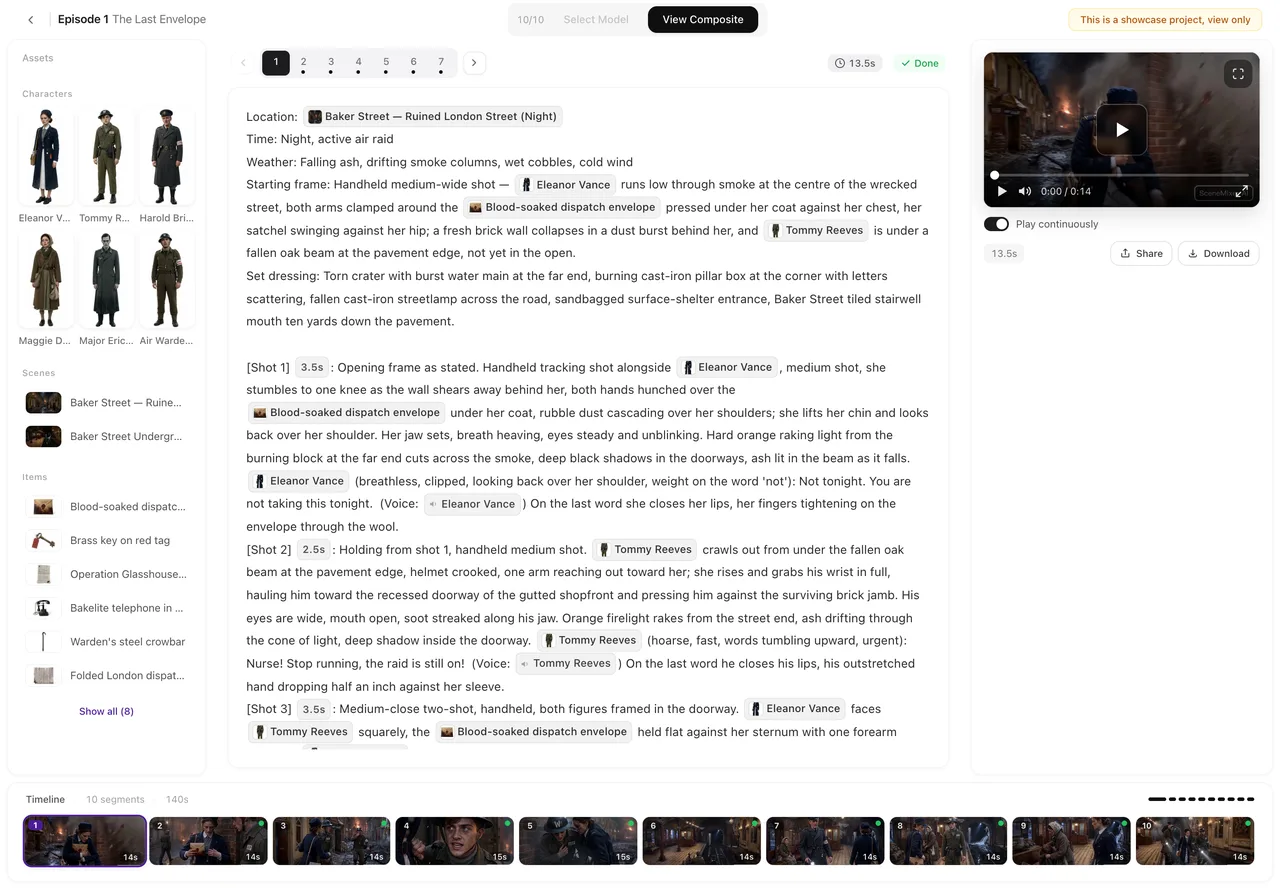
Three things. The picture: the top tier renders at 2K — the larger pixel count of the two — and MiniMax H3 Fast renders at 768P for drafts and phone screens. The cut: a segment can hold several shots with real cuts between them inside one generation, so an exchange and the reaction to it can live in a single render; the storyboard’s shot list is the edit. The sound: every generation includes dialogue and ambient sound — there is no silent mode.
The tiers are picked the usual way: the button in the episode editor’s top bar, or Settings → Model Preferences → Video Model. Whatever you set governs what you render next — a segment already made is untouched, and each version remembers the tier behind it.
What each tier costs per second
Two tiers on a single bill, charged per second of rendered picture.
| Tier | Price per second, in credits | Cost, at the lowest credit price | Longest run | Resolution |
|---|---|---|---|---|
| MiniMax H3 | 25 | $0.16 | 15 seconds | 2K |
| MiniMax H3 Fast | 16 | $0.10 | 15 seconds | 768P |
What changes between the two is the resolution and the rate; the segment ceiling and the reference budget belong to the family and are shared by both. A draft on MiniMax H3 Fast can be re-rendered as a keeper on MiniMax H3 without touching anything else.
What you can make with it

Above is a still from The Glass Floor, which this site took from script to composite on Wan 3.0 · 720P. The setting carries the same flow to a MiniMax H3 tier — reference budget permitting.
Where the family earns its place: a short, dense beat — a confrontation that turns, a reveal with its reaction, anything that fits in a single segment and wants the larger picture; and a segment built from a few cuts, since the shots can be cut inside the generation rather than stitched together from separate renders.
There is room for several episodes in a project too: they sit in order, each rendering as its own chain of segments, and any shot inside them can pick its own tier.
The reference budget, in practice
This family keeps its own numbers: up to nine images and three voice clips per generation, with about 14 s of voice in total. A voice clip also needs an image alongside it — a segment that would carry voices with no image has its voice clips dropped, and each speaker falls back to the written voice description.
When a segment would go over a limit, the site leaves out the least important references first, so the usual failure is a voice changing or a prop losing its sheet rather than a refusal. A segment that names a crowd and attaches a sheet for every face will hit the cap; fewer, more deliberate references carry further here. Segments that need the whole cast attached are better kept on a Wan step, where the budget goes to ten images and five voice clips.
How to start
Count the cast before the tier switch: a MiniMax H3 segment will take up to nine images and three voice clips, and no more — a scene that wants a sheet for every face may need trimming first, or it belongs on a Wan step. When the count works, Select Model is the switch, and only the segments rendered afterwards move.
Money-wise the family bills like the rest of the site: the read of the script, the reference sheets beyond each account’s free allowance, and the rendered seconds each carry their own charge. The purpose-by-purpose ranking places both H3 tiers, and the H3-or-Wan comparison is the longer read.
FAQ
What does MiniMax H3 cost per second?
On this site: 25 credits per second on MiniMax H3 and 16 on MiniMax H3 Fast — about $0.16 and $0.10 at the lowest credit price. You are charged once the segment lands; a failure sends the credits back, or parks them until support checks the task.
How many references does a MiniMax H3 segment take?
Up to nine images and three voice clips per generation, with about 14 s of voice in total — and a voice clip needs an image alongside it. When a segment goes over, the site leaves out the least important references first; a character whose voice is dropped speaks from the written voice description instead.
Can a MiniMax H3 generation run long?
No. Every segment tops out at 15 seconds on both tiers. For an unbroken longer take, the Wan steps run to 30 seconds — the two families mix happily inside one episode, since each segment keeps its tier.
Which of the two MiniMax H3 tiers should I pick?
Draft on MiniMax H3 Fast and finish on MiniMax H3 — the pair runs on the same rules (a single generation of up to 15 seconds, the same reference budget, sound in every render) and differs in resolution and rate: 25 credits per second on MiniMax H3 against 16 on MiniMax H3 Fast. Each tier has its own page: the top tier and Fast.
MiniMax H3 or Wan 3.0?
Come back to Wan for the two things this family cannot do: hold one unbroken take — a Wan step runs to 30 seconds where a segment here closes at 15 — and carry a deep reference list, ten sheets and five voice clips per generation against the nine and three available here. A crowded frame that wants a sheet on every face will shed references on this side; on a Wan step it fits. Stay with MiniMax H3 when the moment is short and dense, when the picture wants 2K, or when the cuts belong inside the segment rather than between renders — MiniMax H3 Fast brings the same texture in at 768P where that is enough. The side-by-side guide works through both directions.
Try the family on a dense segment
Paste a script, keep the references lean, and render the segment you want watched large on MiniMax H3.
Updated October 14, 2026
Pricing·Novel to Video·Guides·Samples·Alternatives·Answers·Support·Privacy·Terms·Legal·Contact·Affiliate program·© 2026 SceneMixer