Alternatives
An LTX Studio Alternative for AI Drama Series
Updated October 13, 2026

A studio toolkit, or a production line
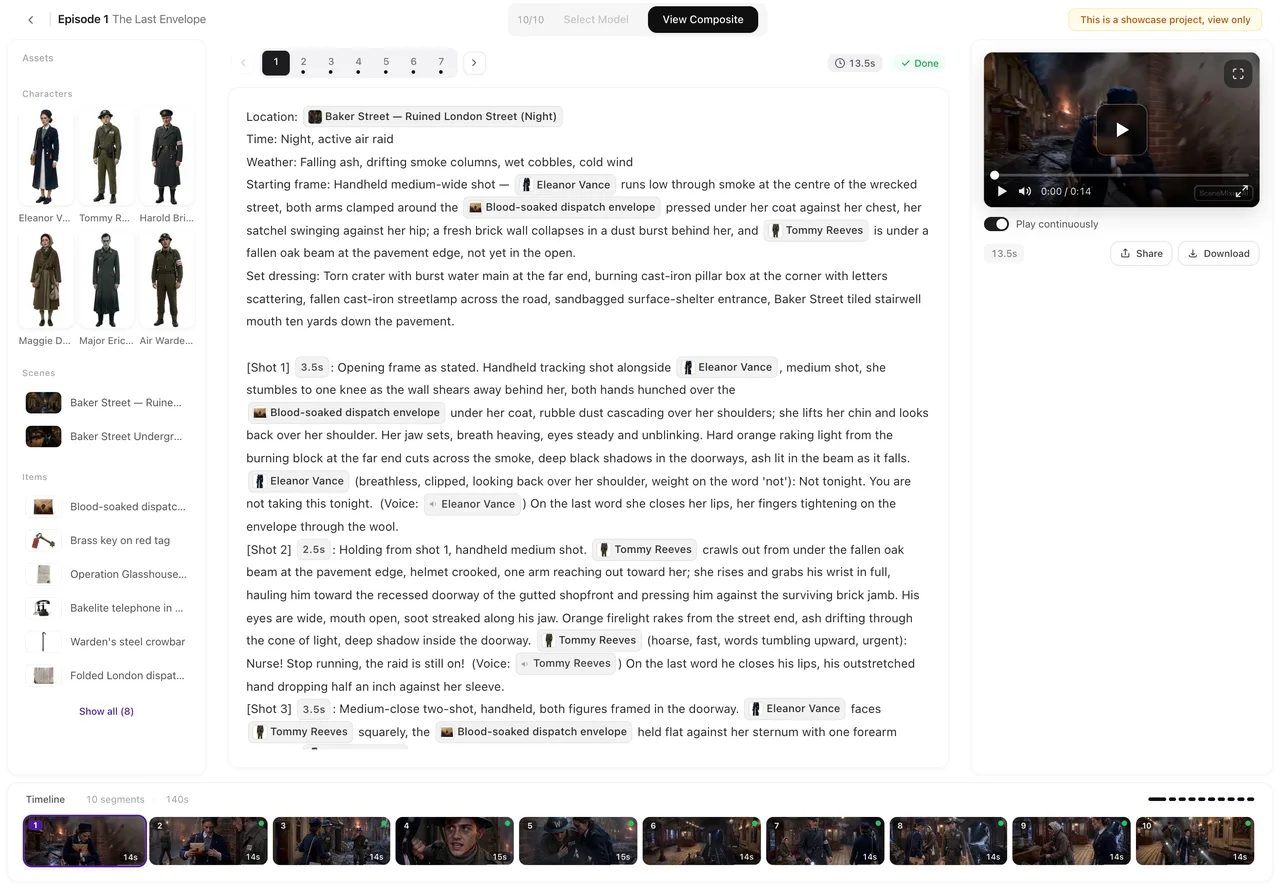
LTX Studio's plans add tools as you go up: AI storyboards, pitch decks and consistent Elements from Standard, collaborators per project on Pro, custom model training on Enterprise1. SceneMixer is one pipeline that every project runs through, so the storyboard, the cast and the video are always connected to the script that produced them.
At a glance
| LTX Studio | SceneMixer | |
|---|---|---|
| Built for | “Professional creator, marketer or filmmaker” plans with storyboards, pitch decks and node-based Flows1 | One series project: script → cast → episode outline → storyboard per episode → video per segment → one file per episode |
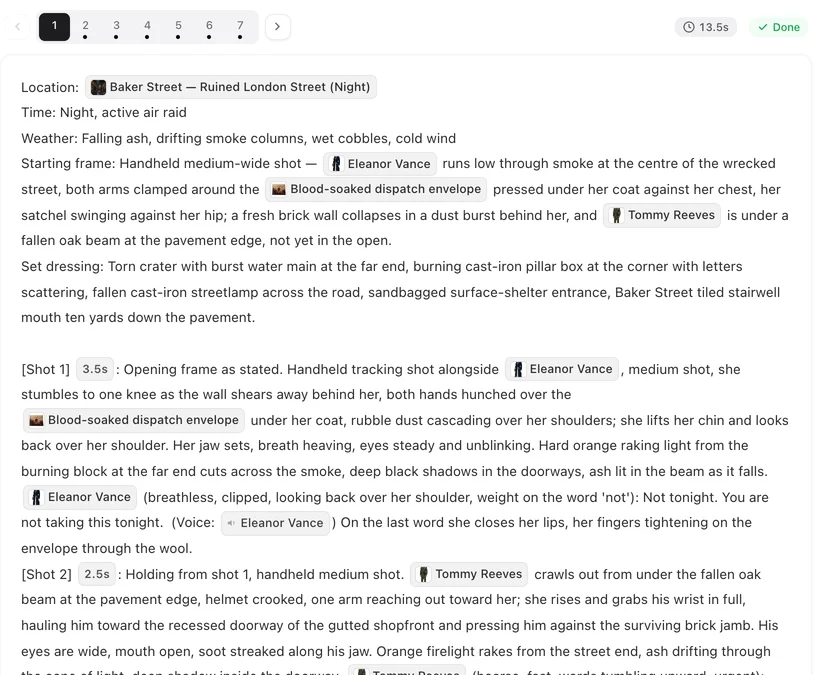
| Storyboards | Blank storyboards on Free; AI Storyboards from Standard1 | A storyboard is written for every episode from the script, shot by shot, and stays editable |
| Keeping a character | “Save and create consistent Elements” from Standard1 | The cast is generated once as reference sheets and attached to every segment a character appears in; paid plans can upload their own image instead |
| Camera | Advanced camera controls on every plan1 | The camera move is written into each storyboard shot as text you can edit |
| Dialogue | Dubbing and captions are listed in the plan comparison1 | Lines are performed in the generated video itself, in any of 15 languages (Cantonese as a 16th dialogue option) |
| Licence | Free: personal use licence; commercial use licence from Standard1 | You own the results, including commercial use, on free allowances too; uploads and outputs are not used to train models unless you agree. |
| Price to start | Free: 800 one-time credits; Lite $15/month ($12 billed yearly) with 8,000 credits; Standard $35/month ($28 billed yearly) with 28,0001 | Credit packs from $1.49; Pro plan $7.99/month with 700 credits. New accounts get 50 free credits and 15 free reference images. |
Models differ between platforms, so compare a test clip of your own scene, not only the price per second.
What a fixed cast looks like


Stay with LTX Studio if…
- You are pitching or pre-visualising. Pitch decks and AI storyboards are part of LTX Studio's plans1.
- You want node-based automation. Flows lets you wire generation steps together1.
- You want specific named models such as Veo 3.1 or Kling 3.0, which its plans list1.
- Several people work on one project. Pro includes 3 collaborators per project; Enterprise has unlimited collaborators1.
SceneMixer fits if…
- You are telling a story in episodes. One read of the script returns the cast, locations, props and an episode-by-episode outline with an end-of-episode hook; each episode gets its own storyboard. Upload a script and read it.
- Your cast should speak a particular language. Pick it in step 1 and the lines are performed in that language as the shot renders — no dubbing pass. Native dialogue vs dubbing.
- You are adapting one story for a market. The target region adapts names, casting and scenery for Western, East Asian, Southeast Asian or Latin American audiences. Relocate a story by region.
- You want commercial rights from the first credit. Our terms give you ownership of the results, including commercial use, on free allowances too.
- You would rather pay as you go. Packs start at $1.49 and plan credits stay in your balance. Do credits expire?
Where LTX Studio lands in SceneMixer
| In LTX Studio | Closest step in SceneMixer |
|---|---|
| Elements | Character, scene and prop sheets in step 2. Regenerate or replace one sheet |
| AI Storyboards | The storyboard written for every episode. How to write one shot |
| Camera controls | The camera line of each shot in the storyboard |
| Dubbing | Dialogue performed in the video in the project's language. Native dialogue vs dubbing |
Moving a story over
- Bring the script you storyboarded — paste it or upload .txt, .docx or .md.
- Set the project in step 1: Type (Short Drama, TV Series or Film), aspect ratio, dialogue language and target region.
- Reuse character art you own. On a paid plan, upload it in place of a generated sheet; otherwise generate sheets — the first 15 on an account are free.
- Draft cheaply, finish the keepers. Generate at the lowest tier, then regenerate only the segments that will be seen most at a higher resolution. Draft at 480P, finish at 1080P.
Frequently asked questions
Is SceneMixer an LTX Studio alternative?
For turning a written story into a multi-episode drama, yes. For pitch decks, node-based automation, team collaboration or choosing specific named models, LTX Studio has more tools.
How much does LTX Studio cost?
On October 13, 2026, its pricing page listed Free (800 one-time credits), Lite at $15 a month or $12 billed yearly (8,000 credits), Standard at $35 or $28 billed yearly (28,000 credits) and Pro at $125 or $100 billed yearly (110,000 credits). Check its pricing page for current prices.
Can I use LTX Studio's free plan commercially?
Its pricing page lists a personal use licence on Free and a commercial use licence from Standard. SceneMixer's terms give you ownership of results, including commercial use, on free allowances too.
Does SceneMixer write the storyboard for me?
Yes. Every episode gets a shot-by-shot storyboard written from the script, with durations, the cast in each shot and the lines; you can edit any of it. How to write one shot.
Do SceneMixer credits expire?
Plan credits and bought credits sit in one balance and do not expire at the end of the month.
Sources and corrections
- LTX Studio pricing (ltx.io/studio/pricing) — plans, credits, features, models, licences and FAQ
Facts about LTX Studio come only from the pages listed above, as checked on October 13, 2026. Prices and plans change often, so check LTX Studio's site before you buy. LTX Studio is a trademark of its owner and is named here only to identify the product; SceneMixer is not affiliated with it. Spotted something out of date? Email support@scenemixer.com and we will correct it.
From script to series in one project
Outline, cast, storyboards and video, all connected.
Start a project freeCredit packages from $1.49 · Pro $7.99/mo · No credit card to start
Pricing·Novel to Video·Guides·Samples·Support·Privacy·Terms·Legal·Contact·Affiliate program·© 2026 SceneMixer