How to Write One Shot

Open a finished episode and read three shots in a row. Every one of them follows the shape below.
The shape
[Shot 3] 4s: Medium shot, fixed camera. @Mara at the head of the table, @Jules on her right. She slides the @Sealed letter across to him and holds his eye. @Mara (low, steady): Read it before you say no. (voice: 🔊Mara) @Jules lips closed, no lip movement. Rain on the window behind them.
Marker and seconds. Framing and camera. Who is where. What happens. The line, with its delivery note and voice chip. What the other person is doing. What we hear. That order is the one a viewer notices things in, and it is the order that reads best.
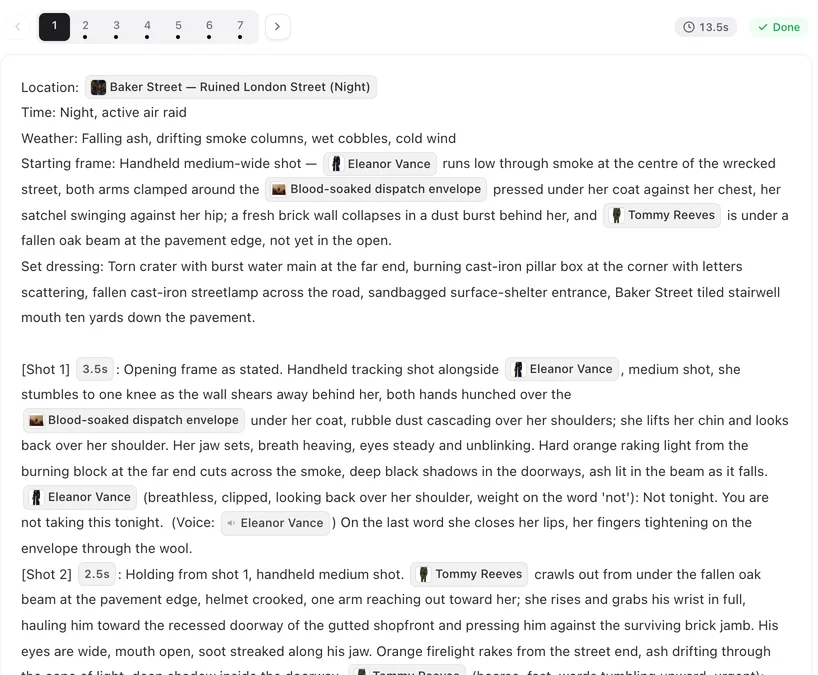
Framing and camera
Say the size of the picture: close-up, medium close-up, medium shot, full shot, wide shot. Say whether the camera is still or moving: fixed, handheld, tracking, a slow push in. Say the angle if it matters: over @Jules’s shoulder, from the doorway, from the passenger window. One framing per shot; a change of framing is a new shot.
You do not have to write the camera position at all. Say who faces whom and the scene’s automatic AI 3D staging puts the camera where that is true. How positions hold.
Who is in the picture
Name everyone visible with an @ chip. For one person, add In frame only: @Mara. Do not name someone who is only heard or only nearby. A listener gets lips closed, no lip movement. Who is in frame.
One thing happens
A shot is one beat: she slides the letter; he picks it up; she looks away. Two beats are two shots. Write what is visible — hands, faces, bodies, objects — not what someone is thinking. “She hesitates, then slides the letter across” works; “she decides to trust him” gives the shot nothing to draw.
Start the first shot with Opening: and the first frame; start each later shot with the cut, such as Cut to close-up:. When the same people are in two shots in a row, change the framing or the angle between them, or the join looks like a skip. Say posture when it is not standing: kneeling, seated, leaning on the rail.
The line
@Name (how it is said): the words. Then the voice chip from the @ menu. Delivery notes are short and physical — low, steady; through her teeth; calling from the stairs. A line from outside the picture starts its note with (voice-over) or (off-screen). Dialogue lines.
Give the line its seconds: about three words a second in English. Shot seconds.
What we hear
End the shot with the sounds of the place if they matter: Ambient: rain on the glass, a clock in the hall. A shot with no speech gets No dialogue so nobody is made to talk.
Three shots to copy
A reaction. [Shot 4] 3s: Close-up. In frame only: @Jules. He looks down at the letter, jaw tightening. No dialogue. Ambient: rain.
A line with movement. [Shot 5] 6s: Medium shot, handheld. @Mara stands and crosses to the window, back to him. @Mara (quiet, not turning): I already know what it says. (voice: 🔊Mara)
A reveal. [Shot 6] 4s: Slow push in on the @Sealed letter on the table; the seal is broken. No dialogue. Ambient: the clock.
| Part of the shot | Example |
|---|---|
| Marker and seconds | [Shot 3] 4s: |
| Framing and camera | Medium shot, fixed camera / Close-up, slow push in |
| Who is where | @Mara at the head of the table, @Jules on her right |
| One thing that happens | She slides the letter across and holds his eye |
| The line | @Mara (low, steady): Read it before you say no. (voice: 🔊Mara) |
| The listener | @Jules lips closed, no lip movement |
| Sound | Ambient: rain on the window |
FAQ
How long should a shot be?
Two or three seconds for a look or a gesture, four to six for a line and its reaction, longer for movement. The shots add up to the segment.
Do I have to write the camera position?
No. Name who faces whom and the staging places the camera. Write a position when you want a specific one.
Can a shot have two actions?
Better not. Split it into two shots; each gets its own seconds.
What if nobody speaks?
Write No dialogue at the end of the shot.
Should I describe what a character is thinking?
Describe what shows: the face, the hands, the pause. A thought with no visible sign gives the shot nothing to draw.
Write one shot and generate it
Open a segment, rewrite a single shot in this shape, save, and regenerate that segment.
Updated October 2, 2026
Pricing·Novel to Video·Guides·Samples·Support·Privacy·Terms·Legal·Contact·© 2026 SceneMixer