Answers · Platform money
Can You Monetize AI Videos on YouTube and TikTok?
Published October 14, 2026

The label is not the gate
Start by deleting the most common worry. YouTube's disclosure rules require a creator to flag realistic content that was altered or generated with AI — and then say, in the same document, that disclosing does not limit a video's audience or its eligibility to earn. The label exists so the platform and the viewer know what they are looking at; it is not a demerit. TikTok's community guidelines take the same shape: creators must label AI-generated or significantly edited content that shows realistic-looking scenes or people, and the enforcement target is the unlabeled upload, which may be removed, restricted, or labeled by the platform's own team.
So the disclosure question is administratively boring by design. If your episode reads as filmed reality, tick the box; if it announces itself as drawn or stylised, both rulebooks soften or skip the requirement. The interesting question — the one that decides whether a channel earns — is one layer up.
What actually costs you the money
Both platforms police the same thing under different names: uploads that were assembled rather than made. YouTube's monetization policy carries the clearest line, and it was sharpened in July 2025 when the older "repetitious content" section was renamed inauthentic content and extended to cover content that is repetitive or mass-produced. The policy's own examples go straight at this niche. Not allowed: AI-generated content made with generic or unoriginal templates that implies mass production without adding the creator's original, authentic insights. Allowed: using AI to visualize a unique character and narrative you invented, or to edit scripts and backgrounds inside work that is otherwise yours. The dividing line is contribution, not tooling.
Two more clauses matter for anyone planning a series. Channels that use AI-generated personas to deliver guidance on sensitive topics — health, legal, financial, political — are named as ineligible for monetization, and videos that stitch together unrelated AI clips to hold attention are on the not-allowed list. TikTok's comparable line is about originality and it is written into feed eligibility: content with reused or unoriginal material and nothing new added is ineligible for the For You feed. The same page keeps a hard line on intellectual-property violations, and its commercial-disclosure rule still applies on top of everything else — if you are promoting a product, brand or business, the content disclosure setting is mandatory.
What the community reports
The corpus shows how rarely this is a pure AI question. Posts carrying a YouTube-monetization label number 15 — the smallest painpoint in the collection — while the social-platform label spans roughly 15,000 posts across the corpus. Platform trouble is common; formal demonetization talk is not. When it does appear, it reads like this, from a music-video creator whose uploads were suppressed:
I'm surpressed and demonetized now on YouTube but it won't stop me making these and more of me.
That post is a release thread, not a post-mortem — which is typical. The lengthier cases in the corpus are people pasting the platform's enforcement notice and asking how to appeal, like this line that one creator quoted from YouTube's own suspension message:
While your channel is demonetized you should not attempt to monetize new channels to get around these restrictions.
That message is the clue to reading every case like it: enforcement arrives at the channel level, after a pattern, not per video. Nothing in the corpus shows an otherwise original channel losing access because it labeled its AI content — and the policies, read plainly, do not provide that mechanism.
What a SceneMixer episode carries over
Every episode you generate is yours to publish — download the finished files and post them to YouTube, TikTok or a short-drama platform. What travels with the file is the corner badge, on by default on a free account and off by default on a paid membership, with the switch documented on the badge guide. A video shared through a link always shows the AI label, even on a paid plan, while your own download is unaffected; the composite comes down as the original-quality file, with a lighter play version used for the browser and the share page.
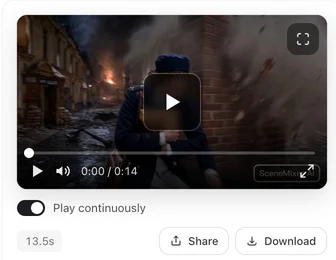
What SceneMixer deliberately does not do is interpret the platforms for you. The posting guide covers formats and captions; the monetization question stays where the platforms put it — in their own documents, which change on their own schedule. The product's role is narrower and more useful: stamp the badge by default and let paid members remove it.
When a policy does not apply the way you expect
- Both policies were read on October 14, 2026 and both get revised without ceremony. A rule quoted here today can be a renamed section tomorrow, as the July 2025 update showed.
- Monetization and ad suitability are separate systems on YouTube. A video can earn from ads, be fine for memberships, and still be limited in recommendations — the disclosure page and the monetization policy do not resolve each other.
- "Originality" is judged as a channel pattern, not a single upload. One template-shaped video rarely triggers anything; a feed of them is exactly what the policy describes.
- TikTok's unoriginal-material line is about the For You feed, which governs distribution; payout programs add their own terms on top of it. This page does not read those terms for you.
- Nothing here is legal or platform-policy advice, and neither platform consults this site about enforcement. The links above are the authority; we are the reading.
FAQ
Can a channel that posts only AI videos monetize?
Yes, if the videos are the kind each platform describes as original work — the same yardstick applies to any upload. YouTube's policy names visualizing a unique character and narrative you invented as allowed, and names template-driven output without your own insight as not.
Does the AI label reduce earnings?
No. YouTube states directly that disclosing altered or synthetic content does not limit a video's audience or its eligibility to earn. The label tells the platform and the viewer what the video is; it is not itself a penalty.
Are the two platforms' rules the same?
Close but not identical. YouTube runs a monetization policy on inauthentic, mass-produced content. TikTok's equivalent line is about unoriginal or reused material, and it affects eligibility for the For You feed. Both platforms require a label on realistic AI content.
What does a SceneMixer file carry to the platform?
Your download is the master file, with the corner mark unless a paid membership switched it off, and a share link always shows the AI label.
The policy documents behind this page are YouTube's synthetic-content disclosure rules and its channel monetization policies, plus TikTok's integrity and authenticity guidelines — all read on October 14, 2026. The community counts come from the collection method home to every page in this column. If the label question itself still feels tangled, the label page sorts law from platform from tool; the business side of the corpus is in what the money talk shows, and where to post the results safely is in the board-by-board data.
Publish work that passes the real test
Label it, download the master, and let the platform's reviewer meet something you actually made. Start with any script.
Sign up freePolicy links on this page were opened and read on October 14, 2026; rules change, and the platform documents are the authority.
Pricing·Novel to Video·Guides·Samples·Alternatives·Answers·Support·Privacy·Terms·Legal·Contact·Affiliate program·© 2026 SceneMixer