Answers · Labels and disclosure
Do AI-Generated Videos Need a Label or a Watermark?
Published October 14, 2026

Three different things wear the word label
Put three people in a room and "label" means three different objects. The first is a legal disclosure: a duty someone now has to tell viewers that a video was generated or manipulated rather than filmed. The second is a platform declaration: the box you tick during upload, which decides whether the app shows its own tag under your video. The third is the tool's own mark: a corner stamp the generator burns into the pixels, or metadata it writes into the file.
They get conflated because in practice one video can carry all three. But they answer different questions. The law asks whether the audience could be misled. The platform asks whether your upload is what it says it is. The tool's mark answers a third question entirely: how anyone downstream can tell the file came out of a generative pipeline. The distinctions matter because the obligations land on different parties: the legal duty mostly binds the makers of generative systems and the publishers of deepfake-like content, while the declaration is entirely on the uploader, which is you.
What the 2026 rules actually ask for
The European piece is Article 50 of the AI Act (Regulation (EU) 2024/1689), the transparency article, which applies from August 2, 2026. It splits neatly in two. Providers of generative systems — the companies, not their users — must mark outputs in a machine-readable format and make them detectable as artificially generated. Deployers, meaning whoever publishes the result, must disclose content that is a deepfake: an image, audio or video that resembles real people, places or events. Works that are evidently artistic, creative or fictional get a lighter touch — the disclosure only has to be noted in a way that does not spoil the work. The European Commission's own summary of the act says the same in plainer words: providers of generative AI have to ensure that AI-generated content is identifiable.
California moved along the same timeline. The California AI Transparency Act — SB 942, as amended by AB 853 in October 2025 — requires covered providers, meaning public generative systems with more than a million monthly users, to offer a free tool that can check whether a file came from their system, to let users attach a visible "AI-generated" manifest disclosure, and to embed a latent, machine-readable one. It became operative on August 2, 2026, after AB 853 pushed the original January 1, 2026 date back to match the European calendar, and violations run to $5,000 each. Big platforms get their own provenance duties from 2027, and cameras from 2028. Links to the chaptered bill texts are in the notes below; both were checked on this page's date.
The community watched this arrive with more guesswork than lawyering. One post on a general AI board announced it in a single sentence, and the framing stuck:
A new law is coming to California. You must watermark an AI video to make it clear it's AI…
The same boards also run the opposite errand — people hunting for video that carries no mark at all. A thread written to bury that search opens with the perennial question:
Where can I find a 100% free, unlimited, watermark-free AI video generator?
The corpus counts both moods directly. 350 posts carry a watermark-or-branding label, and 68 cluster around the California question specifically. Zoom out, though, and the label conversation arrives through a bigger door: the platform-policy label sits at 400 posts, while the deepfake-and-ethics label reaches 2,000. People ask about labels mostly because they are worried about what realistic AI looks like to everyone else.
Where the platforms ask you to tick a box
Both major video platforms turned disclosure into an upload step, and both describe the trigger as realism rather than AI use. YouTube's rule asks creators to disclose when AI meaningfully alters or generates photorealistic content: a real person shown saying something they did not, footage of a real event changed, a realistic scene that never happened, or a synthetic music performance as the focus. Photorealistic uploads can get a label in the player itself; stylised or animated ones get a note in the description instead. YouTube also says plainly that disclosing does not limit a video's audience or its eligibility to earn, and that failing to disclose consistently is what draws enforcement.
TikTok's guidelines take the same line in one sentence: creators must label AI-generated or significantly edited content that shows realistic-looking scenes or people, and unlabeled content may be removed, restricted, or labeled by the platform's own team. What is interesting is what the same page excuses from disclosure — small edits like colour correction, reframing or cropping; artistic styles like anime; and generic narration voices that are not recognisably somebody real. AI content that misleads about matters of public importance is banned outright, label or no label.
Read together, the platform rules define the honest middle of this page: if your episode looks like filmed reality, declare it; if it announces itself as drawn, most of the machinery does not apply. For a fuller sweep of who requires what — including likeness and copyright, which this page deliberately leaves out — the 2026 compliance checklist walks the same sources in more detail.
What this site puts on the file
SceneMixer takes the positioning question away and answers it with a default: every finished video carries a small corner mark, the AI badge, applied at delivery. On a free account it is always there. On a paid membership it is off by default — the badge is one of the membership's stated benefits — and the control sits next to the model picker in the editor, showing what the next render will carry. Two boundaries keep it honest: the switch only affects videos generated after you flip it, because each segment keeps the badge setting it was generated with, and share links always show the label even on a paid plan, while your own download is unaffected. The terms prohibit removing or altering the marks, watermarks or provenance metadata yourself.
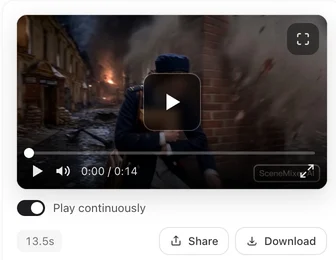
If you publish an episode somewhere that runs its own declaration step, the two systems stack without arguing: tick the platform box, and decide separately whether you want the pixel mark as well. The reason shared videos keep the badge has its own short guide — the gist is that a link travels beyond the settings screen it was made under.
When a formal label does not apply
- This page is a reading of public rules, not legal advice. Nothing here decides your case — a lawyer does, if the stakes are real.
- The rules move. Both bills and both platform pages above were read on October 14, 2026, and each carries its own update cycle; re-check before a release you care about.
- The legal duties mostly bind providers and platforms rather than the individual uploader. For a typical series published outside deepfake territory, the practical checklist is the platform declaration plus the site's own mark.
- The light-touch clauses are narrower than they read. "Evidently artistic" and "stylised like anime" cover the look, not a video engineered to pass as real footage of a person who exists.
- A label is not a shield. TikTok bans misleading AI content whether or not it is labeled, and a disclosure tick has never saved a video that broke another rule.
FAQ
Is a watermark the same thing as a label?
No. A watermark is burned into the picture; a label is a declaration that travels with the upload — a disclosure tick, a platform tag, or embedded provenance data. The rules that matter for platforms are about the declaration.
Does a label hurt my reach or my earnings?
Both platforms say the opposite. YouTube states that disclosing synthetic content does not limit a video's audience or its eligibility to earn. TikTok asks for the label on realistic AI content and treats unlabeled uploads as the problem, not labeled ones.
Can I remove the SceneMixer badge from my own video?
Every video on a free account carries it. On a paid membership the mark is off by default and you can switch it back on; the control only affects renders made afterwards, and the segments already generated keep the setting they were made with.
Do stylised or anime videos need a disclosure?
The trigger everywhere is realism. TikTok's rules say a disclosure is not needed for artistic styles like anime or for generic narration voices, and the EU duty targets content that resembles real people, places or events. Keep the cut stylised and the category softens.
The legal texts on this page are Regulation (EU) 2024/1689 (Article 50, applicable from August 2, 2026) and SB 942 as amended by AB 853, both read in the chaptered versions. The community counts come from the collection method behind this column; the practical side of publishing with a declaration is in what the platforms pay for, and the posting formats are in the board survival data.
Ship with the mark, not against it
Every episode this pipeline delivers carries the corner mark by default — and every share link keeps it. Publish first, litigate the semantics never.
Sign up freePolicy links on this page were opened and read on October 14, 2026; this page is general information, not legal advice.
Pricing·Novel to Video·Guides·Samples·Alternatives·Answers·Support·Privacy·Terms·Legal·Contact·Affiliate program·© 2026 SceneMixer