Answers · Screenwriting
Can AI Write a Screenplay?
Published November 17, 2026
Why writers reach for AI
The blank page is the oldest problem in screenwriting. A director who had happily shot other people's scripts described what happened with their own:
The problem is, when I sit down to write my own script, I get stuck.
That came from a thread in r/Filmmakers about learning to write. Story adaptation and scripts form a large subject in the community corpus, about 7,300 posts. An AI draft does not replace the writer, but it gets past the empty page and gives you something to argue with.
Write the brief, not the script
The quality of an AI screenplay is set by the brief. One or two sentences are enough if they contain the right things: the genre, a lead who wants something, what is in the way, the ending you want and the tone. "A quiet drama: a retired ferry captain teaches his granddaughter to sail the week before his boat is sold; one harbour, no villain, a bittersweet ending" will produce a far better draft than "a sad movie about a boat". On SceneMixer you paste the brief into AI Create, pick a length from Mini to Long and press Start Writing.
Read the draft for three things
Check every scene for one place, every line for whether it can be said in its seconds, and every episode or act for a turn at the end. Those are the faults AI drafts most often have, and the ones that matter most when the script is going to be filmed. Then rewrite: sharpen the brief and write again, or edit the text directly. Every draft stays in Writing History, so nothing is lost.
From screenplay to screen
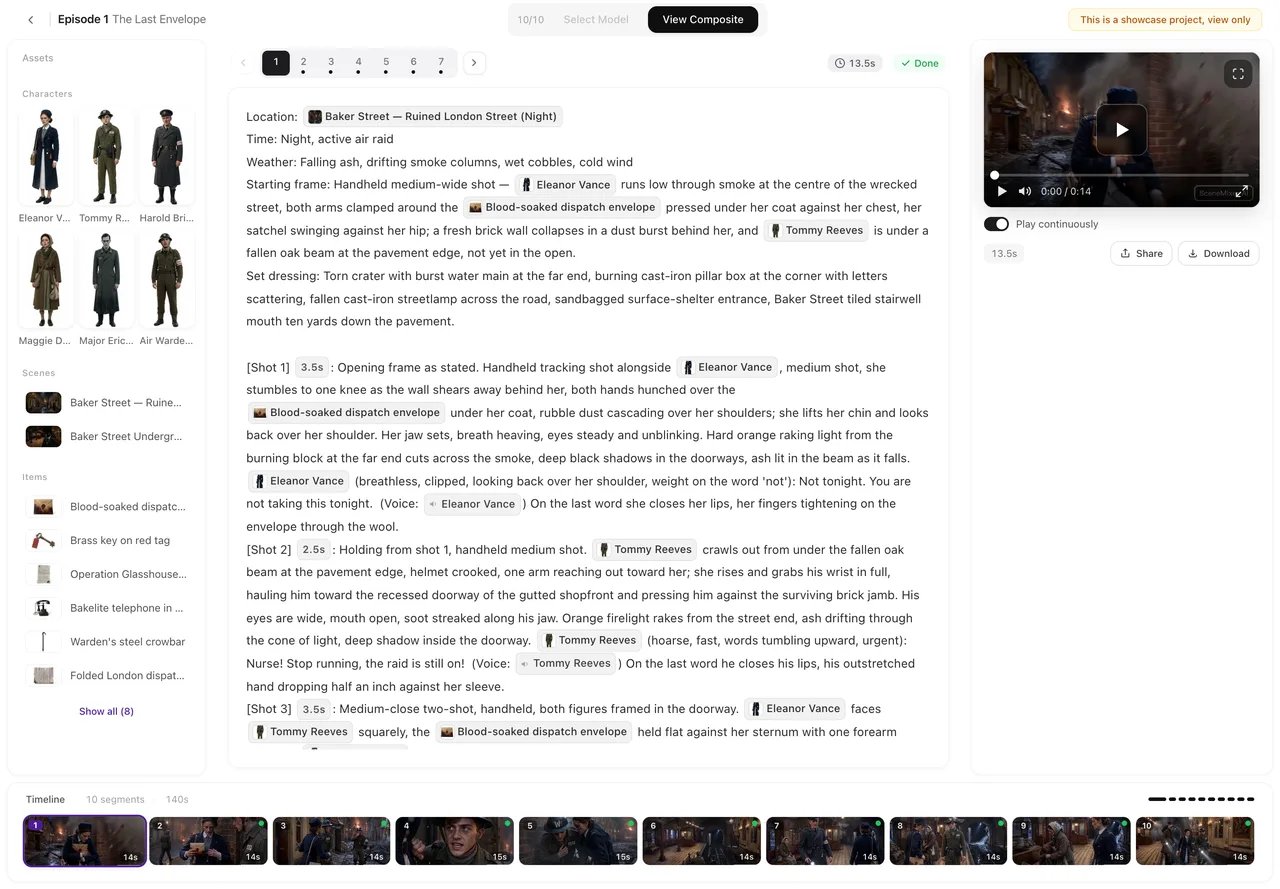
A screenplay on SceneMixer is not the end product; it is the input. The script is read into characters, places and scenes, the characters are drawn once as reference sheets, and each scene becomes a storyboard of shots with seconds and spoken lines. Dialogue written as dialogue is carried into the storyboard and spoken in the video. A script written anywhere else — in screenwriting software, by hand, by another AI — can be pasted in instead, and standard screenplay layout is read as it is.
An example brief and what to check
Suppose the brief is: a heist thriller; a museum night guard who has never broken a rule discovers that the painting she guards is a forgery and that the thief is her own brother; she has one night to decide; the ending is ambiguous. The draft will give you scenes, a structure and dialogue in minutes. Then check it like an editor. Is every scene in one place? Does the guard want something specific in each scene? Are there lines that announce feelings instead of hiding them? Is there a moment the audience will not see coming? Mark those spots, rewrite them yourself or sharpen the brief and generate again, and compare the drafts side by side in Writing History before choosing one to film.
What AI screenwriting does well, and badly
It is good at structure, at getting a premise into scenes quickly, and at producing serviceable dialogue in many languages. It is weaker at subtext, at surprising choices and at a voice of its own; drafts can feel familiar. Treat the draft as a first assistant's work: useful scaffolding that a writer then makes specific. The decisions that make a story yours — who these people are, what they would never say — are still yours to make.
Limitations of AI screenplays
- Drafts lean on familiar structures; originality comes from your brief and your rewrite.
- Long speeches have to be split into shots when the script is filmed.
- Scripts about real people or existing franchises are refused at the filming stage.
- Writing is charged by length; each option shows its price before you start.
- The story-adaptation count is a rule-based label over a fixed window of public posts.
FAQ
Can AI write a movie script from an idea?
Yes. Type the idea as a short brief in SceneMixer's AI Create, pick a length, and you get a script with scenes and dialogue to rewrite.
How to use AI to write a movie script that sounds human?
Give a specific brief, then rewrite the dialogue yourself. SceneMixer keeps every draft in Writing History, and you can edit the text directly.
Is an AI-written screenplay good enough to film?
As a draft, often; check each scene for one place, lines that fit their seconds and a turn at the end.
Can I paste a screenplay I wrote elsewhere?
Yes. Standard screenplay layout is read as it is, and the dialogue is kept.
Related: writing a film script with AI, turning a script into an AI movie, and the collection method behind the count.
Write a brief
Genre, a lead who wants something, an obstacle, an ending, a tone. Then read the draft.
Sign up freePer-second video rates are on the pricing page with the same numbers.