Answers · Writing
How to Write Screenplay Dialogue?
Published November 18, 2026

What screenplay dialogue has to do
Dialogue in a screenplay is not a transcript of how people talk. Real speech is full of repetition, false starts and small talk; screen dialogue keeps the feel of speech and throws away the rest. Every line has to earn its place by doing at least one of three things: showing who the character is, moving the scene to a new situation, or making the audience lean in because something is being left unsaid.
It also has to be said by an actor, which is the test writers forget. A line that reads well can be impossible to speak, too long for one breath or full of sounds that trip the tongue. A thread in r/Filmmakers asks the question plainly:
How to write proper dialogue.
The advice below starts from the same place: say it aloud, cut it shorter, and let the action carry what the words do not.
How dialogue is laid out on the page
Screenplay format makes dialogue easy to find. The speaker's name is written in capitals above the line, indented toward the centre. A parenthetical, a short direction such as (quietly) or (to Sam), sits under the name only when the line would otherwise be read the wrong way. The words follow in a narrower column. A line heard but not seen is marked after the name: V.O. for voice-over, O.S. for a speaker off-screen in the same place.
| Element | What it is for |
|---|---|
| Character name | Who speaks, in capitals, every time they speak |
| Parenthetical | A brief delivery note or who the line is aimed at; use sparingly |
| Dialogue | The words, in their own column |
| V.O. / O.S. | A narrator, a phone voice or someone in the next room |
Habits that make dialogue read well
- Subtext. People rarely say what they want directly. Let the line circle it.
- Conflict. Two characters who want different things in the same scene give every line a pull.
- Short lines. Most lines are a sentence or two; a speech needs a reason.
- Interruptions. A dash at the end of a line, cut off by the next speaker, keeps a scene alive.
- No "as you know". Characters do not explain to each other what both already know; find another way to tell the audience.
- Distinct voices. Cover the names and you should still know who is speaking.
- Read aloud. Every draft, every scene.
The worst lines tend to fail several of these at once; a thread in the same community asking for the single worst line of dialogue in any movie drew hundreds of replies.
Writing dialogue for AI video
When the lines will be performed by generated characters, the craft rules matter more, not less. Short lines fit a shot; a long speech needs several shots and somewhere for the camera to go. One speaker per shot keeps the right mouth moving. Delivery notes do real work, because there is no actor to interpret a flat line. Talk about dialogue and lip movement is a steady subject in AI video communities, with about 2,600 posts in the community corpus tagged with it.
On SceneMixer, a line is written inside the shot where it is spoken, at the moment it is spoken, after the speaker's chip and a short delivery note. A line spoken from outside the picture starts its note with (voice-over) or (off-screen), and text that should appear on screen is a caption, not a line. The storyboard sets shot lengths from the speaking rate of each dialogue language before any video is generated, so a line gets the seconds it needs.
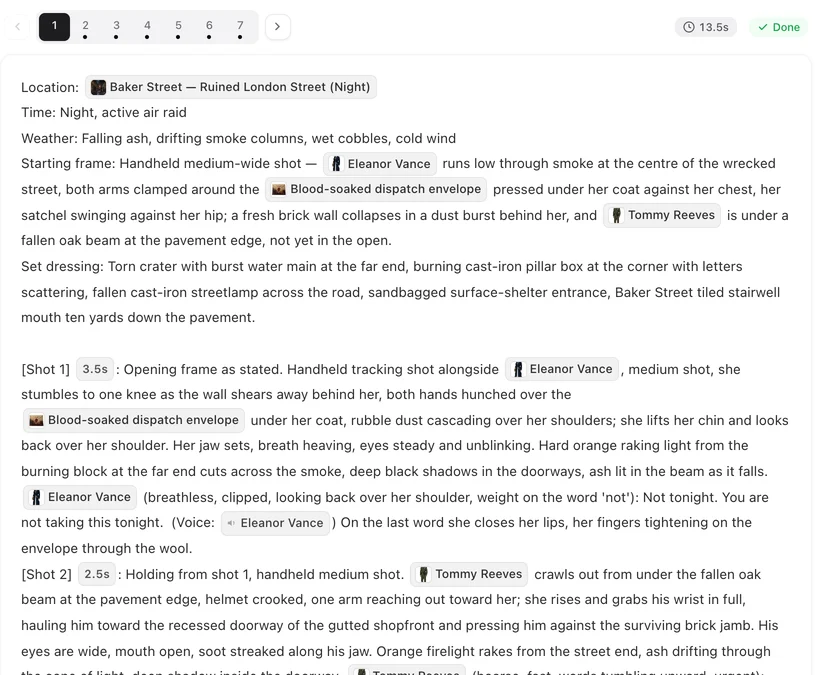
The lines are then spoken in the generated video in the project's dialogue language, with the lips moving to them; how lip sync AI works explains why speech made with the picture fits better than speech added after.
Limitations of these dialogue rules
- Format conventions differ a little between countries and between film, television and stage.
- Generated performances follow the delivery note but cannot improvise; rewrite a line that keeps coming out flat.
- Two people speaking at once in one shot is hard to generate; give each line its own shot.
- The dialogue figure is a rule-based tag over public posts from a fixed period, so read it as a sense of scale; see the collection method.
FAQ
How do you format dialogue in a screenplay?
The character's name in capitals above the line, an optional short parenthetical under it, then the words in their own narrower column. Mark voice-over as V.O. and an unseen speaker as O.S.
How long should a line of dialogue be?
Usually a sentence or two. Longer speeches work when the moment demands one, and they read better broken by action or another character's reaction.
What is subtext in dialogue?
What a character means but does not say. A line about the weather can be a line about a marriage; the audience enjoys working it out.
Can SceneMixer perform the dialogue I write?
Yes. Write each line inside its shot with the speaker and a delivery note; SceneMixer has it spoken in the generated video in the project's dialogue language.
Related: whether AI can write a screenplay, creating a screenplay, dialogue lines, voice-over and captions, writing one shot, and the collection method behind the count.
Write the line, hear it performed
Put dialogue into a storyboard and SceneMixer's cast speaks it in the generated video.
Sign up freePer-second video rates are on the pricing page with the same numbers.