Answers · Film
How to Make an AI Movie?
Published November 17, 2026

Why a movie is harder than a clip
Generating one striking shot is no longer difficult. A movie asks for something else entirely: the same faces for every scene, rooms that keep their furniture, dialogue that is actually spoken, and a story that goes somewhere. Series and film work is the largest subject in the community corpus, roughly 26,000 posts, and the frustration running through it is remarkably steady. A filmmaker new to the tools asked where the real films were:
where is the pursuit of pulling off dramatic dialogue and realistic faces.
A writer asking in r/aifilmmaking put the starting point more plainly:
i have stories i want to bring to light, what are the ones i could use to make it real?
Both point at the same gap. The picture is the solved part; holding a film together is not. Everything below is about the holding.
Begin with words, not footage
A film starts as a screenplay, and on SceneMixer it can start as a single line. In AI Create you type a premise and choose a length from Mini to Long; what comes back is a full script you can read and rewrite. If you already have a screenplay, a treatment or a chapter of a novel, upload it as TXT, DOCX or Markdown and the read keeps your dialogue. Either way the script is read into characters, places, props and scenes, priced at 4 credits per 3,333 characters.
In Step 1, set the type to Film. Short-form drama is paced for a hook every minute or two; Film switches that pressure off, so a scene can breathe and a line can carry subtext. It is also the only type without a cap on how long an episode may run.
One look and one cast, fixed before any footage
Choose the visual style in Step 1 — filmic realism, a game-engine look, anime, 3D animation and many more. It is fixed once you continue, so the film cannot slide into another style halfway through. Then every character the read found gets a full-body reference sheet, and every location gets an image. Those images are the cast and the sets: face and body crops from each sheet are passed into every segment the character appears in, which is what keeps the lead recognisable in the final scene.
Read every sheet against the script before going further. A wrong coat or the wrong age is a cheap image to redo now and an expensive scene to redo later.
Direct the film in the shot list
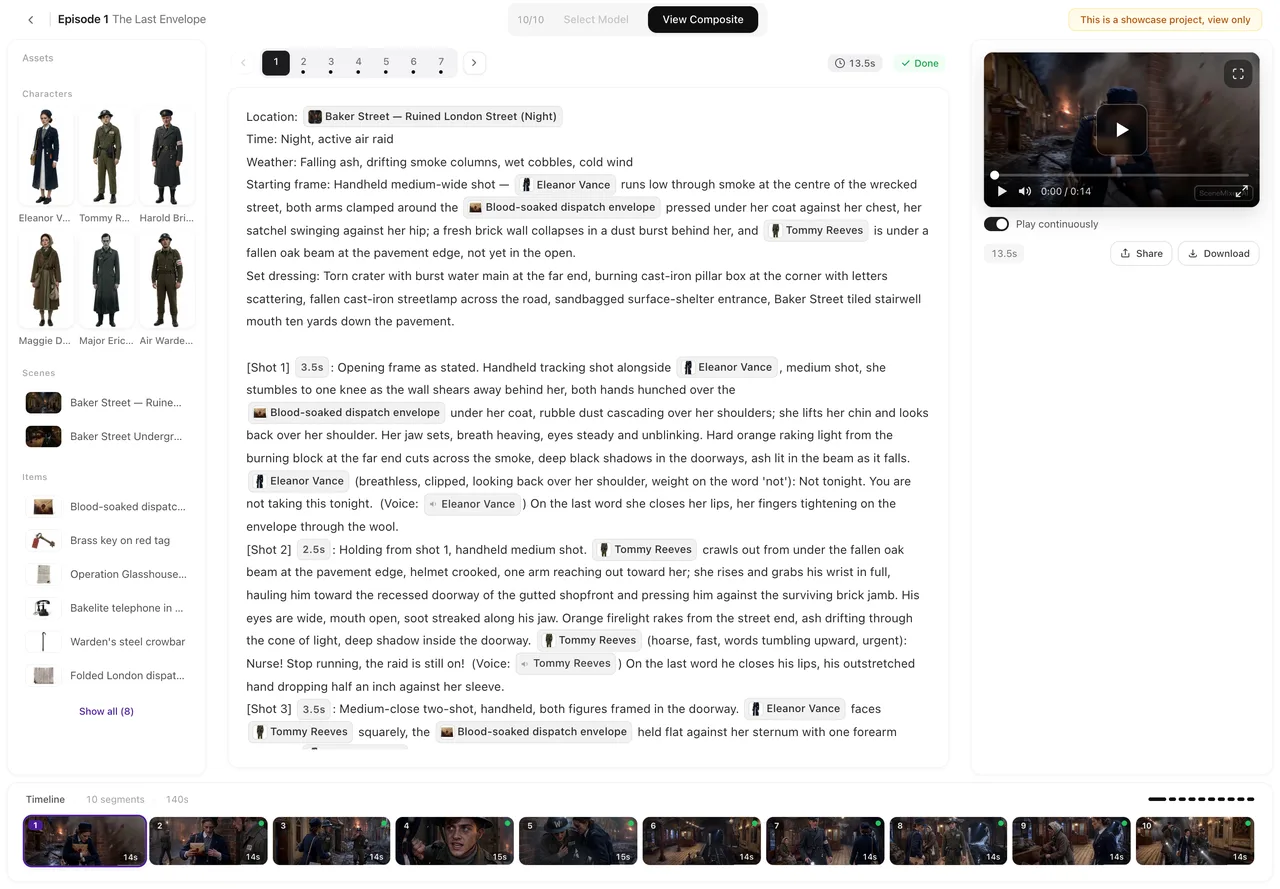
Each scene becomes a storyboard: numbered shots with their seconds, the camera, the action and the spoken line. Editing that text costs nothing, because no model is called, so this is where the film is really directed. Keep one action per shot and give each one enough time to land. Then render. A film is generated segment by segment, a few shots at a time in one place, and the next segment opens where the last one ended, so a walk across a room reads as one walk. If a segment comes back wrong, change its words and regenerate that segment alone; the rest of the film is untouched, and earlier versions stay available.
The cut, the score and the file you keep
When the segments of a sequence look right, join them with one click. Dialogue is spoken inside each segment, one voice per character, in any of 15 languages. A score is added automatically and can be switched off for a dialogue-only version to take into your own edit. Download gives the original-quality file. Title cards and credits are best added afterwards in an editor, because video models do not draw lettering reliably.
Time and money for a short film
Rendering is the quick part. Over the 30 days to November 6, 2026, a typical segment on SceneMixer took about 4 minutes to come back, and segments render side by side, so a longer film adds less waiting than you might expect. The money follows the runtime: from 10 credits a second on the default tier, plus 1 credit a second to join. Plan retakes for the hard shots — crowds, fights, several actions in one frame — because each replaced take is the same seconds bought again. What an AI movie costs and how long one takes break both down.
Limitations of making a film this way
- One continuous take cannot run longer than one segment; a long scene is several segments joined with cuts.
- Real actors' faces, existing films and known characters are refused; the story and the cast must be your own.
- On-screen titles and credits are not drawn reliably, so they belong in the edit.
- Crowded action and many characters in one frame need more attempts than a two-person scene.
- The render time is a one-month snapshot of SceneMixer tasks, refreshed monthly; the community count is a keyword estimate.
FAQ
How to make a movie with AI if you have never made a film?
Start from one line in AI Create and let SceneMixer draft the screenplay; then approve the cast, read the shot list and render one scene before the rest.
How to create an AI movie that keeps the same actors?
Draw each character once as a reference sheet. SceneMixer attaches that sheet to every segment the character appears in, and reuses each location the same way.
How to make a movie using AI from a script you already have?
Upload the screenplay as TXT, DOCX or Markdown and set the type to Film; SceneMixer keeps your dialogue and reads the script into characters, places and scenes.
How long can an AI movie be?
Film type has no episode cap. The film is built from segments of a few seconds each and joined, so its length is a question of budget and patience.
What is AI movie making?
Making a film whose shots are generated by AI models instead of filmed: you still write, cast and plan the cuts. On SceneMixer a script becomes a cast, a storyboard and video segments joined into the film.
Related: what you need before you start, the AI movie maker page with the whole road in one table, what AI movies are today, in numbers, and the collection method behind the community figure.
Write the first scene
One line or a full screenplay. Read the shot list before a single second renders.
Sign up freePer-second video rates are on the pricing page with the same numbers.