What You Can Feed In
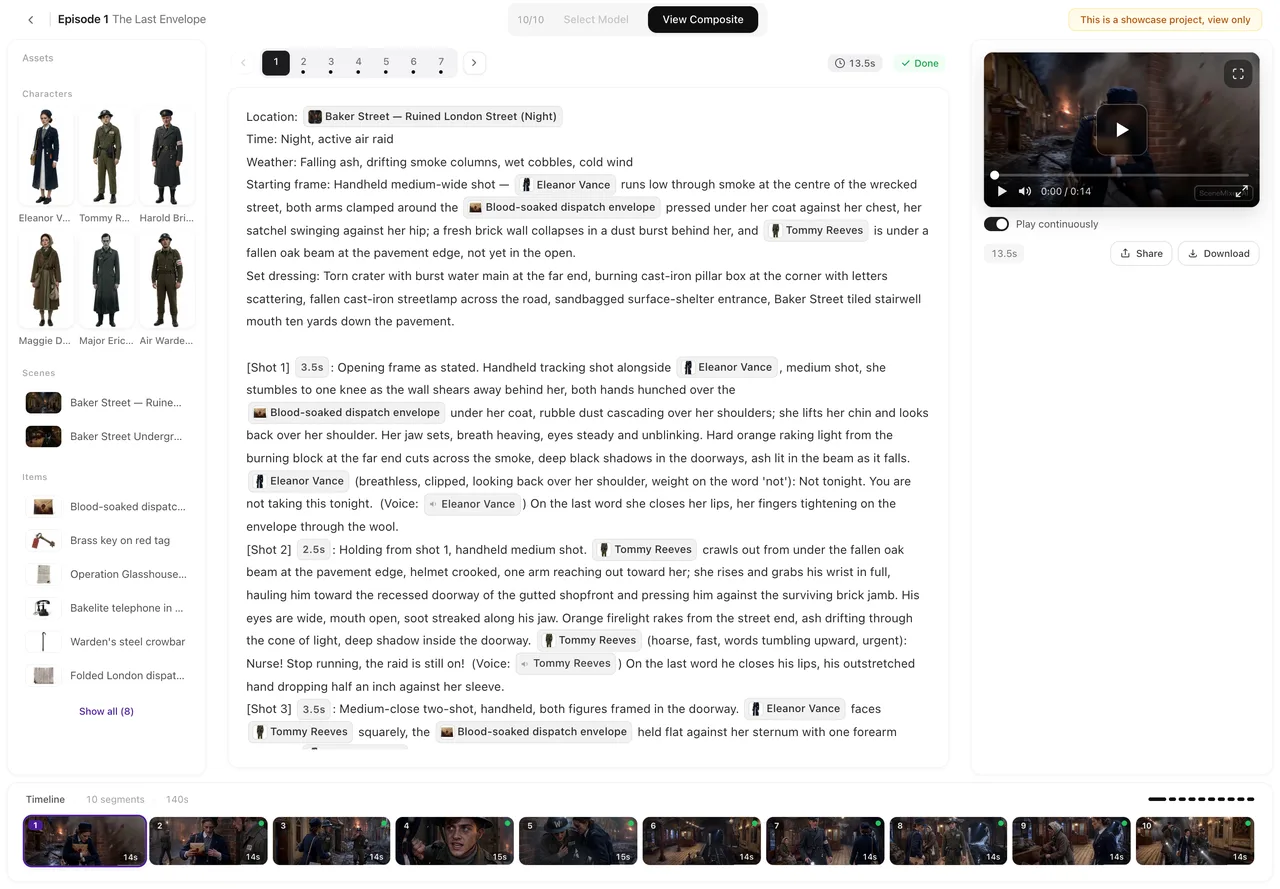
The sample projects were all made through the first door — a block of text and nothing else.
Text: the usual way in
Paste it, or drop a file. We read .txt, .docx, .md and .markdown. A .docx is unpacked to plain text in your browser before anything is sent, so formatting, images and comments inside the document are dropped rather than uploaded.
There is a floor: about a paragraph — roughly 330 characters of English prose, or a hundred Chinese characters. Below that there is nothing to break into episodes. If you paste only a link, you will get a specific message saying so — we do not fetch URLs, and a page of ours reading someone else's page is not something you want in the middle of your billing anyway. Paste the text itself.
There is also a ceiling, and it is a hard stop rather than a silent truncation. Long books are handled by reading them in two passes, which raises the ceiling a lot, and the app applies whichever ceiling matches how your text will be read.
We refuse rather than truncate because truncation does not announce itself. The failure we measured on over-long input is a script that comes back looking complete and is not — a fifty-episode book parsed into ten episodes, with no error anywhere. A refusal in the first second is a better outcome than a plausible-looking result you only catch three steps later.
Any language. The interface is separate from the language your production documents come out in, and separate again from the language your characters speak — there is a dedicated guide on that.
Images: reference material and ad photos
Pick whatever your camera or design tool gave you — WebP, HEIC, PNG, JPEG. Your browser decodes it, flattens any transparency onto white and re-encodes it as JPEG before a single byte goes up. One path, no exceptions, including for files that were already fine.
That is why what arrives is always JPEG or PNG: those are the two formats every step downstream accepts, and converting at the door means the server only has to recognise one shape of bytes rather than trust a file extension. Renaming something to .jpg will not get it through.
The only refusals are files your own browser cannot open — HEIC outside Safari, SVG, camera RAW — and you find that out the moment you pick the file, not three steps later.
For an ad, you can attach up to four photos of the same subject — different angles, a detail, the thing in use. Each up to ten megabytes, sixteen in total. They are read once, for free, before anything is charged, and the read tells you what it thinks the product is so you can correct it before spending.
Video: what remaking does and does not do
MP4 or MOV, up to three hundred megabytes, and no longer than the length shown on the upload box. The upload is read: we cut it into shots and describe the people, places and props in it.
What happens next is the part to be precise about. The source video is never handed to the video model. It is used to understand, and what comes out is generated from that understanding — new characters from your setup images, new framing, new lines. The result will not look like the original, and it is not meant to.
Which means the honest use is your own footage, or footage you hold the rights to: a rough cut you want rebuilt, a reference you shot yourself, something you have permission to work from. We do not review uploads before they are processed, so the rights question is yours, and our takedown process applies to generated files and share links the same as anything else.
Reading the video is charged, because it is a real model call over every shot we cut out. The rest of the project is charged step by step afterwards, the same as any drama.
What the three doors have in common
Behind all three is one pipeline: read the material, produce characters, locations and props, break it into episodes, write a storyboard for each, shoot each segment, composite. Ads and remakes simply have something pressing the next button for you.
That is why the editor looks identical whichever door you came in by, and why a guide written about one of them is usually true of the others.
| Input | Accepted | Limits |
|---|---|---|
| Script text | Pasted, or .txt / .docx / .md / .markdown | At least ~330 characters of English (or ~100 Chinese); a hard ceiling, no truncation |
| Web link | Not accepted | Paste the text instead |
| Reference image | Anything your browser can decode | Converted to JPEG on the way up; checked by bytes |
| Ad photos | Up to 4 of the same subject | 10 MB each, 16 MB total; read free before you pay |
| Source video | MP4, MOV | 300 MB; length as shown on the upload box |
FAQ
Can I give you a link to the story instead of the text?
No. We do not fetch URLs, and pasting one gets you a message saying so rather than a confusing failure later. Copy the text in.
My novel is longer than the limit. What now?
Long text is read in two passes, which raises the ceiling substantially, and the app applies the ceiling that matches how yours will be read. Past that, split it — the limit exists because a read that runs past its budget comes back looking complete while quietly having dropped most of the story.
Do I have to convert my images first?
No. Your browser converts whatever you pick to JPEG before uploading, so WebP, HEIC and PNG are all fine. The only files refused are ones the browser itself cannot decode, and you are told at the moment you pick them.
Does remaking a video copy the original?
No. The source is read, not reshot. The video model never receives it. What comes out is generated from the description — your characters, new framing, rewritten lines.
Can I remake a show I like?
Upload only material you own or are authorised to use. We do not screen uploads before processing them, and the responsibility for rights in what you upload sits with you.
What is the ad price actually covering?
The figure on the button is a cap, not a deposit: it is the most the whole run can cost, and you are charged for the steps that actually happen. For a remake, only the read is taken up front.
Start with whichever you have
A page of text, a few product photos, or a clip you shot. All three land in the same editor.
Updated October 2, 2026
Pricing·Novel to Video·Guides·Samples·Support·Privacy·Terms·Legal·Contact·© 2026 SceneMixer