Answers · Performance
How Do I Get Real Emotion and Acting From AI Characters?
Published October 31, 2026

What viewers are actually judging
A side-by-side acting test in the corpus shows what viewers judge. Its author listed what they were watching:
I was mainly looking at things like eye movement, micro-expressions, timing, emotional transitions, and whether the performance actually feels human
Notice how much of that list is about time: transitions and timing are things that happen between moments, not in one of them. A reply in the same thread went further and judged the scene by the bodies, not the faces:
That's not really consistent with their body language.
Both points lead to the same conclusion. Acting is not a property of a face that a better model unlocks; it is the relationship between what happened, what the character does about it and how long we watch them do it. Those are all things a shot description controls.
Give the character a reason
Emotion starts in the story. A character who has just read a letter, lost an argument or seen someone they thought was gone has something to react to; a character told to look sad in an empty room does not. In SceneMixer, when the script is read, each character also gets a short note of their personality taken from the story, and that note travels into every storyboard written for them. What a character does in a shot, the delivery note in brackets and the words of the line are what the camera actually films — so a scene that sets up the reason in the previous shot gives the next shot something to perform.
Write the cause, then the reaction
Words that describe a result — heartbroken, menacing, overjoyed — tend to be painted on as a fixed face. Words that describe a cause and a physical reaction let the performance happen: she reads the last line, folds the letter along its old crease, and does not look up. A good acting shot usually contains one beat:
- The trigger: what the character sees or hears, ideally in the shot before.
- The first reaction: something small and physical — a breath held, a hand stopping, eyes going to the door.
- The decision: what they do next, which is where the emotion becomes legible.
Keep to one action per shot and give it enough seconds. Two seconds is a reaction; four is a transition. A shot that has to fit a revelation, a reaction and a reply into three seconds will play all three as a blur.
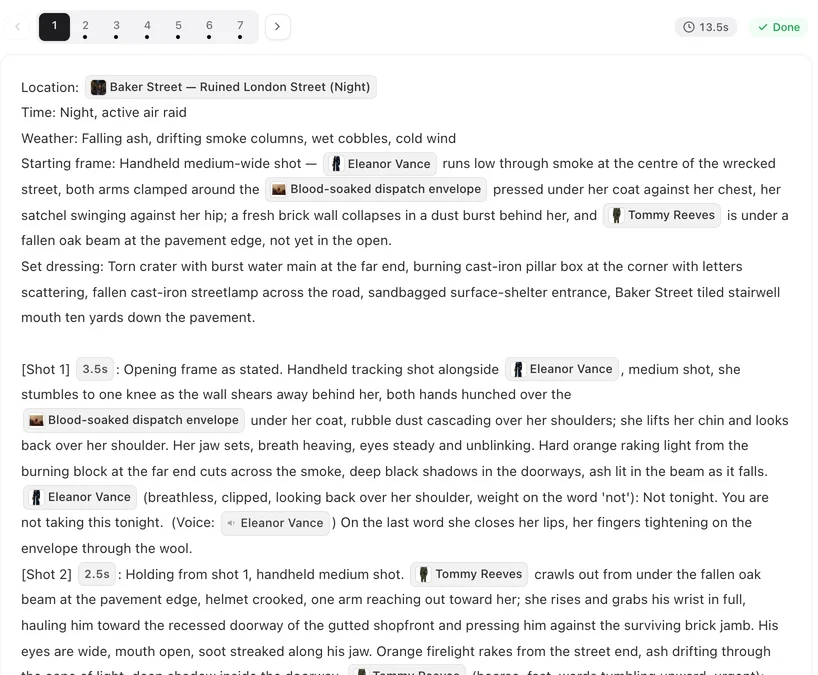
The line carries the delivery
Dialogue is generated with the picture, so how a line is said shapes the face that says it. Each line lives inside the shot where it is spoken: the speaker, a delivery note in round brackets, the words, and the voice that speaks them. "(quietly, not looking at him)" is a direction an actor would recognise, and it is what turns a line from recited to meant. The listener matters as much as the speaker: write what the other character does while the line lands — a jaw tightening, a glance away — and keep their lips closed. Dialogue and lip sync are a large thread of the corpus in their own right, at 2,600 posts.
Close enough to see it
Framing decides whether a performance is visible at all. Small reactions live in close-ups and medium close-ups; a wide shot shows what happened but not what it meant. Cut between the two faces in a confrontation, and change the framing on each cut so the scene reads as coverage rather than a jumpy single shot. When a finished clip is right except for one detail — an expression that is a shade off, for example — changing the expression is one of the fixed edits that can be made to the clip in place, without regenerating the shot.
The test viewers apply is the one a reply under a short trailer in r/aivideo that put emotion over effects named directly:
There is a story, there is a bit of character development, some tension and proper timing.
Limitations of directing in text
- You are directing a model, not an actor: the same text can give a stronger or weaker take each time, so budget for regenerating the key shot.
- Very subtle, long-held performances are the hardest; shorter shots with a clear beat are more reliable.
- Imitating a real actor's face or voice is refused; the performance has to belong to an invented character.
- The comparisons quoted here are individual viewers' judgements, and the counts are rule-based approximations from one window.
FAQ
Why do AI characters look like they are pulling faces?
Because the shot names a result such as sad or angry, which is painted on. Write the cause and a small physical reaction instead, and give it a few seconds.
How do I tell a character how to say a line?
Put a delivery note in round brackets before the words, such as (quietly, not looking at him). The line is performed that way in the same generation as the picture.
Which framing shows emotion best?
Close-ups and medium close-ups for reactions; wide shots for what happened. Change the framing on each cut between two faces.
Can I fix one expression without regenerating?
Yes. Changing an expression is one of the fixed edits that can be made to a finished clip in place.
For the writing side, read giving a character a personality the video shows and writing dialogue in the storyboard; the answer on keeping a voice the same covers the sound. Counts follow the method note.
Direct the scene, shot by shot
SceneMixer writes each line with its delivery and renders voice and picture together; you edit the beats before anything is rendered.
Sign up freePer-second video rates are on the pricing page with the same numbers.