Answers · Prompting
How Do I Write Camera Movement Prompts for AI Video?
Published October 14, 2026

A shot is four instructions in a row
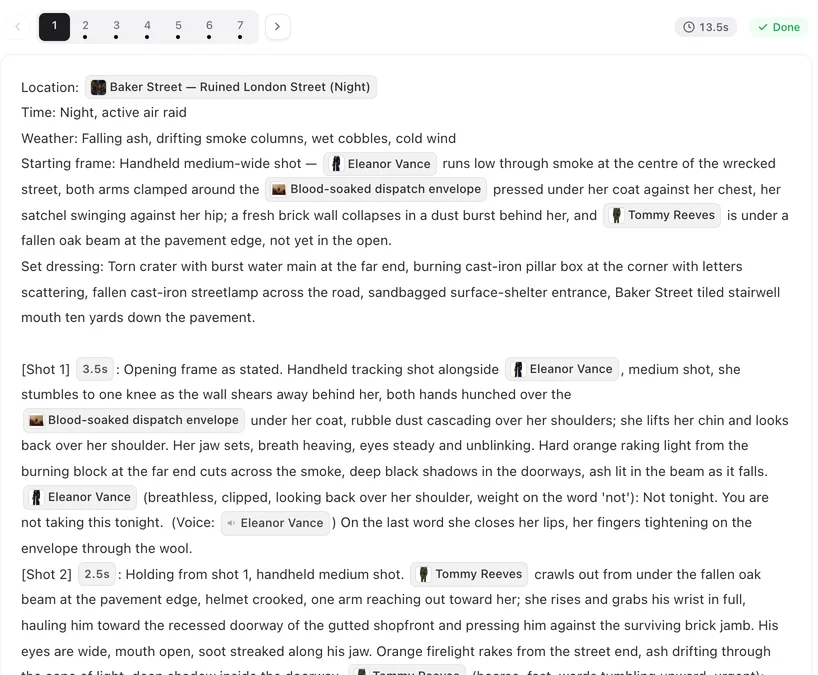
The working unit is a shot inside a segment — a segment is one generation of up to 15 seconds, and every shot carries its own marker and seconds. A well-written shot reads in the order a viewer notices things: the framing (close-up, medium close-up, medium shot, full shot, wide shot); whether the camera is still or moving (fixed, handheld, tracking, a slow push in); who is in the picture; the one thing that happens; the line if there is one. Write what a viewer would see and hear, in that order, and keep to one action per shot. Everything inside the shot rides the same per-second video price — from 10 credits per second — so there is no separate budget line for being precise.
Framing and movement are two separate orders, and each shot gets one of each. One framing per shot; a change of framing is a new shot. If the beat needs to open wide and end on her face, that is two shots, not one sentence that drifts between them. The movement side works the same way: “slow push in” is one instruction a shot can hold, while “starts wide, pushes in, then whip-pans to the door” is really a sequence of shots stacked into one line, and splitting it gives each part the weight it needs.
Angle, depth, and the two framings that exist
Angle words are optional: over the shoulder, from the doorway, from the passenger window. They decide a shot when they matter and clutter it when they do not. Where you have to be careful is depth. Depth words are camera decisions: writing that someone is “in the background, out of focus” behind the speaker has already chosen a camera position — one that often does not exist for a normal two-person mid shot, because for B to sit in A’s depth of field, A has to have their back to B. Two people facing each other have exactly two honest framings: a profile two-shot, or an over-the-shoulder. Ask for “A faces B, B behind her, out of focus” and the renderer has to pick one of the contradictions, which is how you get one person talking to camera with another standing behind them.
The same discipline covers people who are not in the shot at all. Someone who is only looked at, or called to, is written as a direction — “toward frame left”, “eyes on the door behind the camera” — not as a name, because a name makes that person a candidate for the frame. The guide on direction words has the full list.
You often do not need to place the camera at all
Every scene carries an automatic model of its own space, and the staging uses it. Name who faces whom, and the camera is placed where that is true: the camera only cuts to angles that exist, and seats, doors, walls and who stands next to whom hold across every cut. Write a position when you want a specific one — “from the doorway” — and let the rest be geometry. Spatial consistency covers how that model is written and when to override it.
This is also why a camera order belongs in the shot and not in the project's style. Framing is decided per shot in the storyboard, not by the style, and a style text that orders “extreme close-ups throughout” fights every shot's own framing. If a sequence feels wrongly framed, the fix is in the shots — the style axis only decides how the frame is painted.
Four ways the camera line goes wrong
- A framing change hidden in one shot. “Wide, slowly pushing in until it is a close-up” is two shots wearing one sentence. Split it: the wide, then the close-up.
- A depth sentence with no camera that can shoot it. Facing people with one blurred behind them is the classic: it asks one person to face away and toward the other at the same time. Use a profile two-shot or an over-the-shoulder.
- A compound move in one breath. “Push in while orbiting” reads as one camera behaviour asked to be two. Give each move its own shot, or pick the one that serves the beat.
- A person named where a direction was meant. “She looks at Jun” makes Jun a candidate for the frame; “she looks toward frame left” keeps him out of it and keeps her face from drifting.
Where the camera questions cluster
Camera and prompting is one of the largest themes in the corpus — behind only series and film-making — and the recurring questions around it are practical ones:
| What the label counts | Posts |
|---|---|
| Series and film-making labels (the largest theme) | 26,000 |
| Camera-and-prompting labels (this page's topic) | 22,000 |
| Pricing-and-credits labels | 18,000 |
| The shotlist question | 86 |
| The “learn to write prompts like these” question | 58 |
Two comments in the corpus frame the habit this page argues for — camera writing as direction, not decoration:
Its interesting how prompt writing is starting to feel more like directing a film than just describing an image.
The second says the same thing from the working end, when someone wants to copy a reference:
Treat the real clip as a shot list, not as one big prompt.
The first comment comes from a practice thread in the corpus; the second comes from a discussion in r/aivideo. How these counts were collected is described in the method note.
Limitations: when this is not for you
- Camera words do not fix identity. A face that changes between shots is a reference problem, not a phrasing problem — the fixes are in why a character looks different in every shot.
- An angle the room does not contain is not a camera instruction. The staging cuts to angles that exist, so if you need a new vantage, write the space that allows it.
- These are rules of the shot line, not of the whole episode. Long sequences where the camera is the subject need the path planned across segments first — that is the one-take question.
- The corpus figures on this page are keyword-rule counts over the 2026 collection, not a hand-read sample; they show where the conversation is, not a quality ranking.
FAQ
Do I have to write the camera position?
No. Name who faces whom and the staging places the camera; the scene has an automatic model of its own space, so cuts land on angles that exist. Write a position when you want a specific one, like from the doorway.
Can one shot change framing halfway?
No. One framing per shot, and a change of framing is a new shot. If the beat should start wide and end on her face, write two shots instead of one sentence that drifts between them.
Can two people face each other on camera?
Yes, as a profile two-shot or an over-the-shoulder. “A faces B with B blurred behind” is a camera position that does not exist, and the usual result is one person talking to camera with the other standing behind them.
Where does the camera line belong: the segment header or the shot?
The shot. Every segment opens with a header that fixes the facts a camera would need before rolling — the place, the time, the weather, the starting frame — and the framing and the movement live in the shot text that follows.
The mechanics live in how to write one shot — the shape, the examples and the three shots to copy — while shot-to-shot continuity covers what has to stay put between them. If the whole sequence rather than one camera line is the problem, start with how segments and shots stack into a longer video.
Write the shot once, properly
Upload a script, write each shot with one framing and one move, and render it — the first pass is on the free allowance.
Sign up freeImage and per-second video rates are on the pricing page with the same numbers.
Pricing·Novel to Video·Guides·Samples·Alternatives·Answers·Support·Privacy·Terms·Legal·Contact·Affiliate program·© 2026 SceneMixer