Answers · Formats
How to Make Those AI Videos?
Published November 18, 2026

What people mean by "those" AI videos
The question usually arrives with a link and no words. A talking baby complaining about bedtime, an apple and a banana in a soap-opera breakup, a cat narrating its owner's bad decisions, a tiny figure giving a tour of a historical street. One post in r/aivideo asks it in a single line:
Can you tell me how are these videos made
The formats look different, but the question behind them is the same, and it is common: about 98 posts in the community corpus ask how to recreate a video style the poster saw somewhere. The short answer is that none of these clips is a single magic prompt. Each one is a small production with a cast, a script and a format, and the parts are easy to name once you know where to look.
How do people make those AI videos? The same three layers
A character who comes back. The accounts that grow do not post random clips; they post the same baby, the same pair of fruit, the same smug cat, episode after episode. The character is designed once, with one unmistakable trait, and that design is reused in every shot. Viewers follow a face, not a model.
A script with a hook. The first two seconds state a problem or a joke: the baby refuses the vegetables, the banana has been seeing someone else. Then a short exchange, a reaction and a look to camera. Thirty seconds is plenty. The writing does more work than the rendering.
A voice and a frame. Most of these clips speak, and the voice is part of the joke: a grown-up voice on a baby face, a dramatic voice on a fruit. They are framed tall for phones, and they end on a beat that makes the next episode easy to set up.
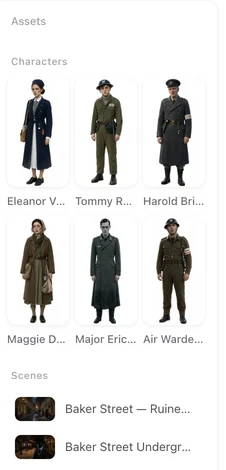
Making one in SceneMixer, step by step
Start a vertical project and paste or write a short script; one sentence is enough for AI Create to draft one. The script is read into characters, places and an episode outline. Each character gets a reference sheet, and face and body crops from that sheet go into every segment the character appears in, which is why the baby on Monday is the baby on Friday. You can edit the storyboard as text, shot by shot, before anything is rendered: what happens, who speaks, and how the line is delivered. Then the segments are generated with the dialogue spoken in the clip and joined into one file you download and post yourself.
Non-human leads work the same way. A fruit, a pet or a robot is just a character with a sheet; describe what makes it recognisable and keep that detail fixed. Photo-real faces of real people are refused as references, so the cast is invented, which is also what keeps an account safe from impersonation complaints.
Which format to start with
Pick the format whose joke you can repeat. A talking baby works when the baby has one obsession that comes back. A fruit drama works when the relationships are clear enough to follow without context. A pet narrator works when the owner is the running gag. A history vlog works when each episode visits one place and one moment. If you cannot write five episode ideas for a format in ten minutes, it is a one-off, and one-offs rarely build a following.
Keep each episode to one location and one problem. Short scripts render faster, cost less and are easier to fix: if one line lands badly, change that line and regenerate that segment, not the whole episode.
Limitations: what copying a viral format will not do
- A format is not a guarantee: the same recipe works for one account and not another, and nobody outside the platform can see why.
- Copying someone's character, voice or exact episode is copying their work; borrow the structure, invent your own cast.
- Some clips you see were edited by hand after generation; a tool will not reproduce every effect in one pass.
- SceneMixer makes the video; posting, captions in the app and growth are up to you.
- The recreate-question count is a rule-based match over a fixed window of public posts.
FAQ
How to make those AI videos Reddit threads keep asking about?
Break the clip into its parts: a recurring character, a short script with a hook, a voice and a vertical frame. SceneMixer builds each part from your script and keeps the character the same in every shot.
How do people make those AI videos with the same character every time?
They design the character once and reuse that design. On SceneMixer the reference sheet is attached to every segment the character appears in.
Can I make those talking baby or fruit videos for free?
You can start free: on SceneMixer a new account's first setup images and first storyboard are free; video is charged by the second once you render.
Do I need editing software to make those AI videos?
Not for the clip itself: SceneMixer joins the segments into one file. An editor helps if you want platform captions or extra effects.
Related: making baby AI videos, recreating a video style you saw online, the AI fruit drama guide, non-human characters, and the collection method behind the count.
Make your own recurring character
Write one short episode, draw the lead once, and bring them back next week.
Sign up freePer-second video rates are on the pricing page with the same numbers.