Answers · Workflow
How Do I Recreate a Video Style I Saw Online?
Published October 31, 2026

Take the video apart before you look for a tutorial
The question usually arrives with a link and no detail: how was this made? A post in r/generativeAI put the feeling well:
I saw some people saying it's ai but I'm unable to comprehend how this is made using our current ai capabilities
Another asks it in the title alone:
How was this made so i can recreate something similar
There is rarely one tutorial, because there is rarely one trick. A reply under a popular request for an urban-exploration style was closer to the truth:
That video is the result of about a thousand prompts re done over and over to ensure the final product.
Whether or not that number is literal, the point holds: a polished video is many decisions. The fastest way to recreate it is to name those decisions yourself. Watch it twice with the sound off, then once with only the sound, and write down five things.
| Note down | Ask yourself | Where it goes in SceneMixer |
|---|---|---|
| The look | Filmed or drawn? Grain or clean? Which kind of animation? | Visual style, chosen once in Step 1 |
| The world | Which period, which city, how crowded, what light? | Scene style and costume style |
| The camera | Handheld or still? Close or wide? Does it follow someone? | The first words of each shot |
| The rhythm | How long does each shot hold? Fast cuts or long takes? | Shot seconds; 15- or 30-second segments |
| The sound | Who speaks, in what voice? Music under it? | Lines in the shots, character voices, the score |
Copying a style: build it from the parts
A style is not owned by the video you saw; it is a set of choices you can make yourself. Once the five notes exist, the project almost writes itself. Pick the visual style that matches the look — the full list is in visual styles, one by one. Pick the scene and costume styles for the world. Then write your own idea, or type one line into AI Create and edit the draft it writes.
The camera and the rhythm live in the storyboard. If the video you admired holds every shot for four seconds on a slow push in, write that; if it cuts every second, write short shots. Segments are 15 seconds as standard or 30 for a long take, and each shot inside one has its own seconds. Questions about turning a still into motion are a whole theme of their own — 2,800 posts — but most style questions are really about these two layers, not about any single image.
Copying a clip: the remake route
Sometimes you want the clip itself — its scenes, its blocking, its lines — with different people. That is what SceneMixer's Remake tab does. Upload one MP4 or MOV within the length and size limits shown on the upload box, and the clip is read shot by shot in four passes: find the cuts, identify the cast, read every shot, then check and save. What comes back is an ordinary project: every person becomes a character, every place a location, every prop that matters an item, and every shot a numbered beat in a storyboard. Spoken lines are heard by speech recognition and quoted into the shots rather than guessed from lip movement, written in the dialogue language you chose.
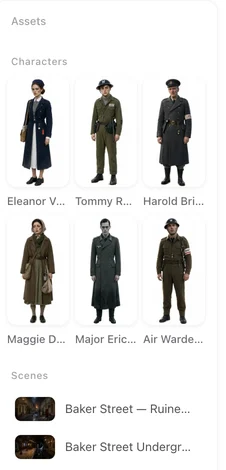
Then you recast. Rewrite a character's appearance, pick a voice, rename a place, and generate the images; the storyboard keeps pointing at the same entries, so the new cast walks through the same shots. To move the whole story to another country, set Target Region in Step 1 before you press Next. Recasting a remake walks through each step.
The price of the read is set by the clip's length alone, rounded up to the next minute, and it is shown before you start; if the read stops partway, the unused credits come back. The source clip is never handed to the video model — that is why the faces in the result are your own cast's — and it is queued for deletion as soon as the read completes. Where your uploaded clip goes.
What you cannot take with you
A style is free to borrow; a specific work is not. Reading a clip does not give you the rights to its story, and the read does not check who owns it — that is the uploader's responsibility. Famous characters, franchises and real people's faces are refused whichever route you take. The source's music is not reused either: if the clip has music, the read notes its character and the episode's own score is written in that tone. If the video that inspired you was built on a celebrity or a well-known film, recreate the style and invent the story. The answer on turning a character sheet into a cinematic video picks up from there.
Recreating a style does not have to mean copying anyone. A creator in r/aivideo took a look from older animation that people called obsolete and started a season of their own in it. One reply noticed how much of the effect came from a single setting:
Even the aspect ratio is doing its part.
That is the five-notes method in miniature: the look, the frame shape, the tape texture and the title card were named and rebuilt, and the story was new.
Limitations of recreating what you saw
- A remake reshoots; it does not copy frames. The framing and faces are new, so the result resembles the source in structure, not pixel for pixel.
- Lines the speech recogniser could not make out — shouting over a crowd, very quiet speech — are left out rather than invented; add them by hand.
- Uploading your own face photo or voice sample to replace a character is a paid-plan feature; describing a new appearance and picking a library voice are not.
- Some looks are not on the list. If the video you saw uses a style none of the presets match, describe the closest and adjust, or — on a membership — write a custom visual style.
- The post counts come from automated rules over a fixed sample of public threads; they show that the question is common, not exactly how common.
FAQ
How do I recreate a video style I saw?
Name its look, world, camera, rhythm and sound, then make those choices in your own project: visual style, scene and costume style, shot lines and shot seconds, voices and score.
Can I upload a video and have it remade?
Yes, with the Remake tab: an MP4 or MOV is read shot by shot into characters, places, props and a storyboard, and you reshoot it with your own cast. The read is priced by the clip's length in minutes, rounded up.
Does a remake copy the original footage?
No. The source clip is never passed to the video model; the shots are generated new from the read, with your own character sheets.
Can I remake a scene from a famous film?
Reading a clip is not a licence to its story, and famous characters and real faces are refused. Recreate the style and write your own story.
Start with how a remake works or the visual styles; the answer on whether a multi-tool pipeline is worth it covers what happens when the video you saw was assembled from several programs. For how the question was counted, see the method note.
Name the style, then make it yours
Pick the look and the world in Step 1, or upload a clip to the Remake tab and reshoot it with your own cast.
Sign up freePer-second video rates are on the pricing page with the same numbers.