Answers · Voice
Is Text to Speech AI?
Published November 18, 2026

From stitched syllables to a model that performs
Older speech synthesis worked like a ransom note made of sound: a library of recorded fragments, glued together by rules. It was intelligible and flat. The voices people now call natural come from neural models trained on many hours of speech. Given a sentence, the model predicts the pitch, timing and breath of a human reading it, and a second stage turns that prediction into audio. That is machine learning in the plain sense, so the short answer to whether text to speech is AI is yes for anything made in the last few years.
What people actually want from it has not changed much. One request, posted in r/generativeAI, is typical:
I need some free ai voice generators with natural and expressive voices.
Voice is a large share of the conversation: about 12,000 posts in the community corpus touch voice, music or sound in video.
Three different things that get called AI voice
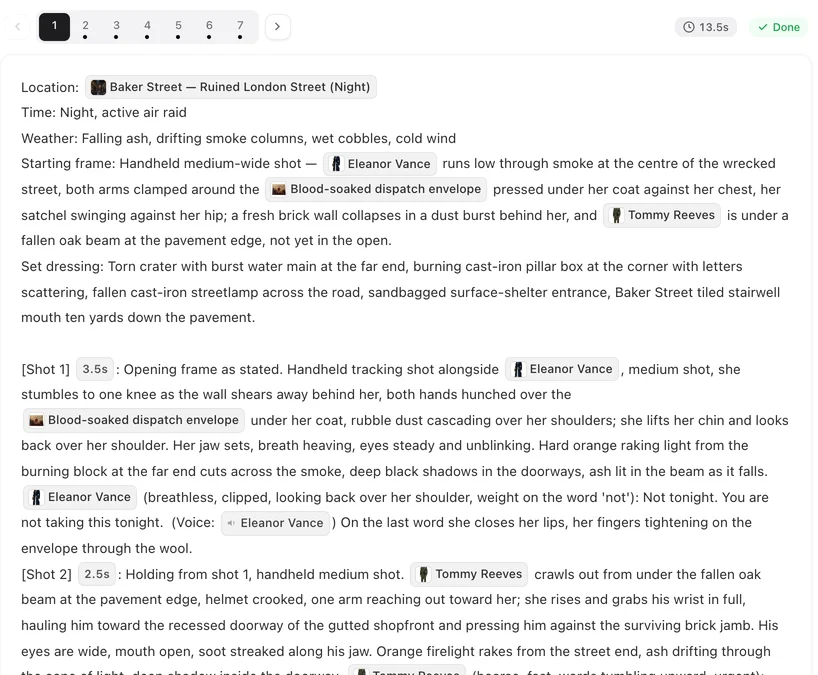
Text to speech reads written text aloud in a chosen voice. It is the right tool for narration over footage you already have, for an audiobook, or for reading a page to someone who cannot see it. Voice cloning learns a particular voice from a short sample and speaks new lines in it. Native dialogue is newer: a video model generates the picture and the speech together, so the mouth movement and the line come from the same model rather than being matched up later.
The difference matters most for faces on screen. A line added afterwards has to be lip-synced, and the eyes and shoulders were never told what was being said. Generated together, a character can take a breath before a hard sentence and look away on the word that hurts.
How SceneMixer voices a character
Each character has a voice of their own. You either describe it in words, with timbre and delivery, pick a match from a preset voice library, or, on a paid plan, upload a recording you have the right to use. When a shot is generated, the speech is created with it. If you only want to change what someone says, Redub speaks the new line in the same character's voice without remaking the picture, which costs less than regenerating the segment.
When plain text to speech is still the better tool
Not every video needs a performer. Explainers, list videos and documentary-style narration over stills are text-to-speech work: one steady voice, no lips to match. On SceneMixer a narrator is an off-screen character with a voice and no image, so a story can have a voice-over alongside characters who speak on camera. For a narration-only video with no characters at all, a dedicated speech tool and a simple editor are the shorter route.
Whichever you use, write for the ear. Short sentences, numbers spelled the way they should be said, and names that cannot be misread. A model reads what is written; it cannot guess that "Dr." should be "Drive" in an address.
Choosing a voice that fits the character
Pick voices the way a casting director would, by contrast. Two characters who share a scene should not share a register: give one a low, slow voice and the other something quicker and higher, and a viewer can follow a conversation with their eyes closed. Age matters more than accent; a twenty-year-old with a fifty-year-old's voice reads as a joke whether you meant one or not. When you describe a voice in words, name the texture (husky, bright, breathy), the pace and one habit, such as trailing off at the end of a sentence. Then listen to a short test line before generating a whole episode. Changing a voice later means the clips already made keep the old one, so the cheapest moment to get it right is before the first segment.
Limitations of text to speech and AI voices
- Emotion follows the writing: a flat line read well is still a flat line.
- Unusual names and invented words can be mispronounced; spell them as they sound.
- Cloning a voice you have no right to use breaks platform rules and wrongs the person it belongs to.
- SceneMixer is built for video with speech in it; for audio-only narration a dedicated speech tool is the simpler choice.
- The voice-topic count is a rule-based label over a fixed window of public posts.
FAQ
Is text to speech considered artificial intelligence?
For modern voices, yes: they are neural models that predict how speech should sound. Older rule-based synthesis was not, and it sounds robotic for that reason.
Is an AI voice the same as text to speech?
Not always. Text to speech reads text in a stock voice, cloning copies a specific voice, and on SceneMixer dialogue is generated together with the picture.
Can I use my own voice for a character?
Yes, if it is your voice to use: on a paid plan SceneMixer lets you upload a recording for a character; otherwise describe a voice or pick one from the preset library.
Do I need a separate text-to-speech tool for narration?
Not for a story with characters: on SceneMixer a narrator is an off-screen character with a voice. For narration-only explainers a speech tool is simpler.
Related: making a video with an AI voice, off-screen and voice-only characters, AI character voices, and the collection method behind the count.
Give one character a voice
Describe it, pick it from the library or upload your own sample, then let the line be spoken in the shot.
Sign up freePer-second video rates are on the pricing page with the same numbers.