Remake a Video: After the Read You Generate the Storyboard — and Why the Result Runs Longer Than the Clip
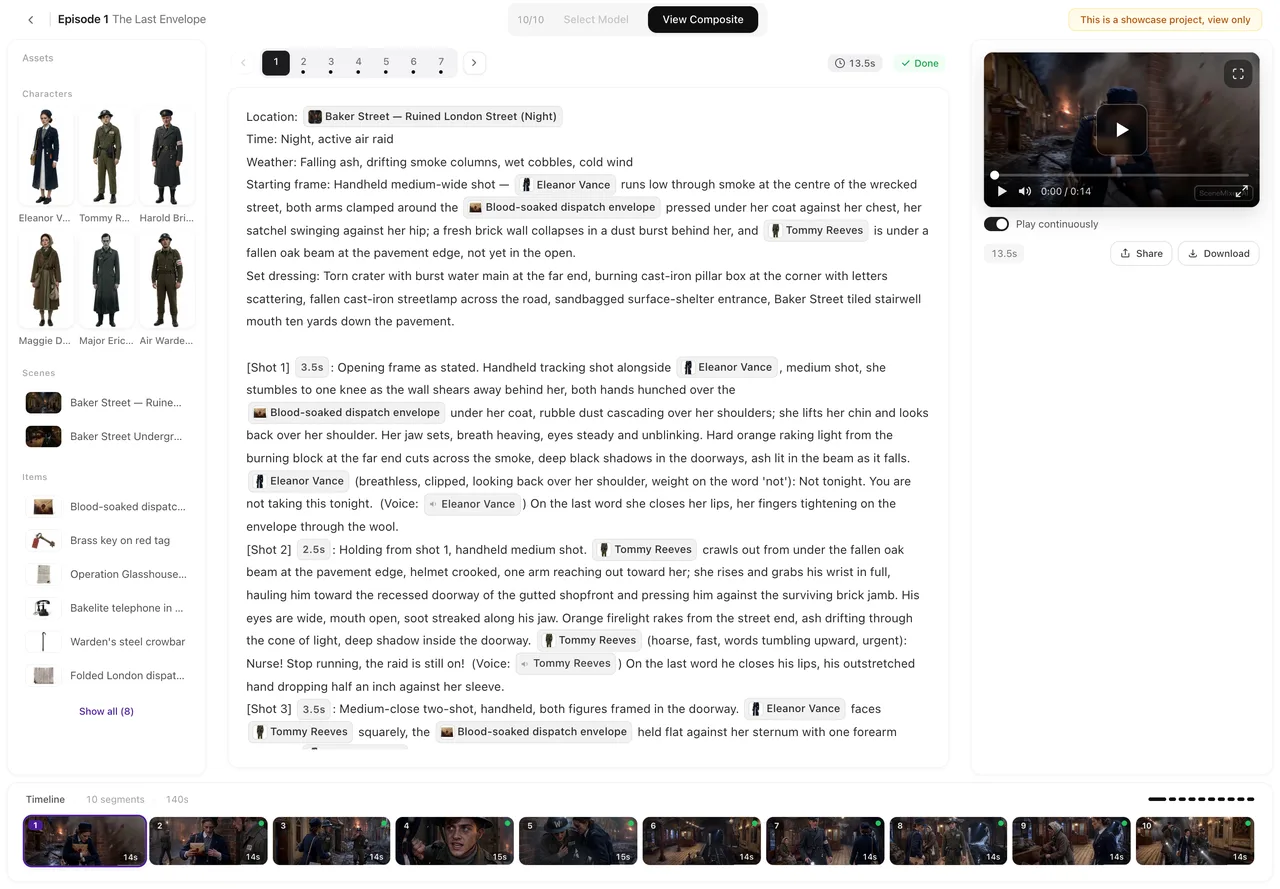
Upload a short clip from the Remake tab; when it says Read, open the project and watch Step 3 offer Generate storyboard for episode 1.
What the read gives you
The read cuts the clip into shots, identifies the people, places and props, listens to every line and writes it all down as one episode: a scene list with prose and dialogue, plus a sheet for each character, place and prop. None of the clip’s frames are used as references for the new video; the cast is drawn from the descriptions, in the visual style you choose. Limits, read time and price of the read itself: Source Limits, Read Time and Price.
Why the storyboard is a separate step
A clip’s cuts are a real editor’s cuts — one or two seconds each — and a video model cannot shoot that. The storyboard step regroups the shots into segments a model can hold, gives spoken lines the seconds they take, writes the light, the camera and the movement for each shot, and runs the same consistency checks as any script. That is why it is generated, not copied, and why it costs the storyboard fee: Generate the Storyboard for an Episode.
Why the result runs longer than the clip
Real actors talk fast and editors cut tight. AI dialogue is paced at reading speed, and each shot gets a minimum of a few seconds, so a 26-second clip with nine lines becomes about 45–60 seconds of video. This is the model’s pace, not a setting; you can trim seconds shot by shot in the editor afterwards, within the limits of the spoken lines. Shot Seconds and Timing.
What it costs, in order
The read (by clip length, within the limit shown on the upload box), then the sheets in Step 2, then the storyboard for the episode, then each segment per second at the tier you pick, then the composite. The estimate shown before the read already scales the video part to the longer running time. Everything after the read is priced exactly like a script project: Where Your Credits Go in One Episode.
Crowds and background people
A group in the clip — guards behind a counter, guests at a table — is not turned into a character with a sheet. It is written into the scene as background people, and the storyboard declares them where they appear, so the video shows a crowd rather than one face copied many times. Recasting the real characters: Recast a Remake.
| Step | What you get | Price |
|---|---|---|
| Read the clip | Scene list with lines, sheets to generate | By clip length |
| Step 1 | Pick the look, aspect, region | Free |
| Step 2 | Generate the sheets | Per sheet |
| Step 3: Generate storyboard | Segments and shots written from the scene list | Storyboard fee |
| Generate segments | Video, about 1.5–2× the clip's length | Per second, by tier |
FAQ
Why is there no storyboard right after the read?
The read writes the story down; the storyboard is written from it in Step 3, like any script, so it can be paced and checked the same way.
Can I make the result the same length as the clip?
You can trim shot seconds in the editor, but spoken lines keep the seconds they need. Expect it to run longer.
Does the remake use frames from my clip?
No. Only the descriptions and the script; the picture is new.
Is the storyboard fee extra?
It is the same fee any episode pays; remake projects do not get the first project’s free first-episode storyboard.
Why does a group of people not get a sheet?
Groups are background people in the scene, not characters; one sheet would put one face on all of them.
Read, pick the look, generate
A remake becomes an ordinary project the moment the read is done.
Updated October 2, 2026
Pricing·Novel to Video·Guides·Samples·Support·Privacy·Terms·Legal·Contact·© 2026 SceneMixer