Answers · Planning
What Is a Storyboard?
Published November 18, 2026

What is storyboarding?
Storyboarding is deciding the shots of a film before making them. A script says what happens; a storyboard says how the audience will see it: from how far away, from which side, for how long, and in what order the views will cut together. Each shot becomes a panel, traditionally a small drawing with notes underneath, and the panels are laid out in sequence so the whole film can be read like a comic before a single take.
The point is to make mistakes on paper, where they are cheap. A scene that will not cut together, a reveal that happens in a shot too wide to see it, a conversation where the characters seem to swap sides of the screen: all of these show up on a storyboard and cost almost nothing to fix there.
Small productions are often the ones that skip it, which a long thread in r/Filmmakers argues is backwards:
Why is storyboarding treated like a luxury when small films need it more?
What goes in a storyboard
Every panel answers the same questions. The framing: a close-up, a medium shot, a wide shot, and the angle. The action: the one thing that happens in this shot. The movement: whether the camera pushes in, pans, follows or stays still, and where the people move. Sound and time: the line spoken or the sound heard, and how many seconds the shot holds. Many storyboards also number each shot so the crew can refer to it.
What are storyboards used for?
- Film and series. Planning coverage, so the director knows which shots the edit will need.
- Animation. Every shot is built from nothing, so the storyboard, often timed into a rough animatic, is the first version of the film.
- Advertising. Selling an idea to a client before money is spent on a shoot.
- Explainers and video for training. Matching each sentence of narration to a picture.
Planning shots is a frequent topic among people making AI video, too; a question about building a shot list for a period piece has about 86 posts like it in the community corpus.
Kinds of storyboards
Thumbnails are tiny rough sketches for the director's own thinking. Shooting boards are cleaner panels for the crew, with arrows for movement. An animatic is a storyboard timed to sound, played like a rough cut. And a written storyboard or shot list describes each shot in words instead of pictures, which is what many productions actually use on set. You do not have to be able to draw to storyboard; you have to be able to describe a shot precisely.
A storyboard in SceneMixer
SceneMixer writes a text storyboard for each episode from its outline. Generating it cuts the episode into segments, each segment a header plus three to five numbered shots with their seconds, the characters and props as @ chips, the lines with voice tags. Each shot reads like a panel in words: the framing, whether the camera moves, who is in the picture, the one thing that happens and the line if there is one; treat each new shot as a cut to a new framing.
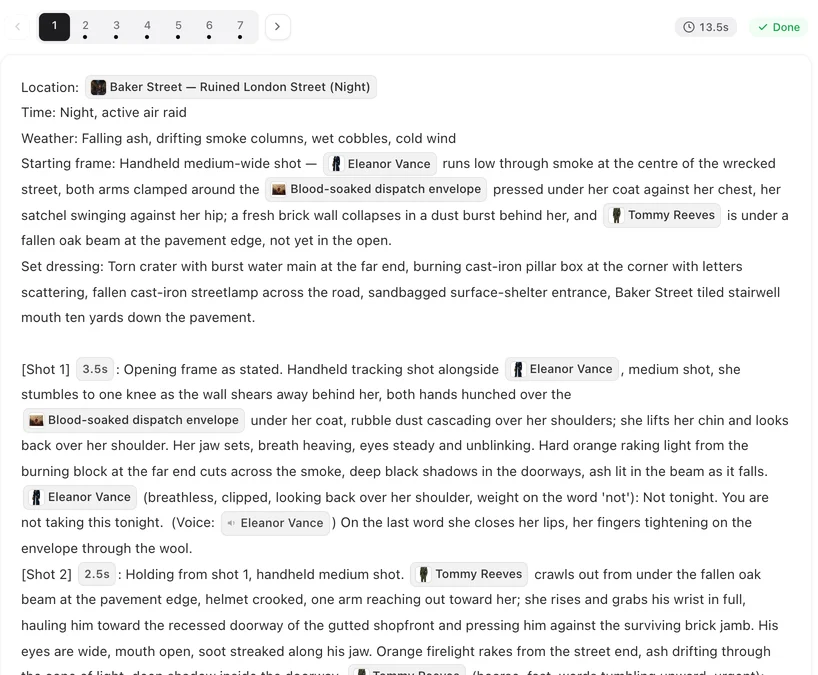
The storyboard is then the instruction for the video: each segment is generated from its own text, so a weak segment can be rewritten and regenerated alone. After the read, the summary, the cast descriptions and every storyboard are editable for free inside the project. How to make a storyboard with AI goes into the working side, from generating to fixing.
Limitations of a storyboard
- A storyboard plans the shots; performance, light and the accidents of a real shoot still change things.
- SceneMixer's storyboard is text, not drawn panels; the pictures come when the segment is generated.
- Very detailed boards can lock a production too early; leave room to change them.
- The shot-list number counts posts similar to one question, matched by rules over a fixed window of public posts; see the collection method.
FAQ
What is a storyboard artist?
A person who draws the panels: they turn the script and the director's ideas into frames that show framing, action and movement, often fast and in rough form.
What is a storyboard presentation?
Showing the boards in order to a client or a team, often with the script read aloud or a rough soundtrack, so people agree on the film before it is made.
Do you need to draw to make a storyboard?
No. Stick figures work, and a written shot list that gives framing, action, movement and timing for every shot does the same job.
Does SceneMixer make storyboards?
Yes. SceneMixer writes a text storyboard for each episode, segments of numbered shots with seconds, characters and lines, and every part of it can be edited before generating.
Related: making a storyboard with AI, creating a screenplay, generating an episode storyboard, the AI storyboard generator, and the collection method behind the count.
Read your film before you make it
Paste a script and SceneMixer writes a shot-by-shot storyboard for every episode.
Sign up freePer-second video rates are on the pricing page with the same numbers.