One Outfit per Character Sheet: Why Two in One Description Fails and Where the Second One Goes

Open a character the parse gave a second look: the state card beside the sheet holds the second outfit, and the sheet shows only the first.
Why two outfits in one description go wrong
The model draws everything the text names, in one picture. Two outfits are two sets of shapes competing for the same body; the result blends them, and the blend is what every later shot is matched to. The same applies to ‘usually X but sometimes Y’, ‘in flashbacks she wears’, and ‘after the fire his clothes are burnt’: each of those is a state, not part of the base description.
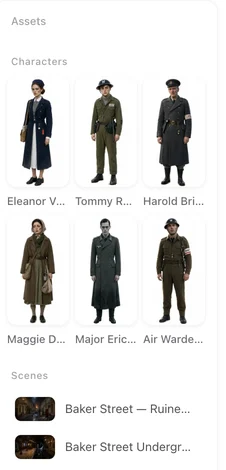
What the site does with labelled outfits
Text of the form Label: outfit. Label: outfit. is split when the parse saves the character: the first outfit stays, each further labelled outfit becomes a state card (a second look with its own image, selectable per scene). Typed into the clothing field later, the extra outfits are only left off the sheet; no state card is made, so add those states yourself. Labels that name a part (Accessories:, Footwear:) are treated as part of the same outfit, not a new one. This is a safety net for scripts that describe several looks at once; the reliable way is to write the states yourself.
Adding a second look as a state
On the character card, add a state: name it (wedding), describe only what differs (the gown, hair up, no glasses), generate its image from the main sheet. Then pick that state for the scenes where it applies; other scenes keep the main outfit. Costume Change and Scene States, Use a State in One Scene.
Keep the outfit sentence short
One sentence: what it is, its cut, its colour, one distinguishing detail. A paragraph on the coat’s embroidery makes the sheet a fashion shot: full-length, small head, the face — the thing that has to stay consistent — lost. Face first, clothing last. Describe a Face.
What goes in the storyboard instead
Costume details that matter in a particular scene (the torn sleeve, the medal pinned on) go into that segment’s text, where the clip is generated; the sheet stays the neutral base everything is matched to.
| Clothing text says | Sheet shows | Do instead |
|---|---|---|
| Overalls; wedding: white gown | A gown with straps, or two half-figures | Overalls on the sheet; 'wedding' as a state |
| Usually a suit, sometimes casual | A suit jacket over a hoodie | Suit; 'casual' as a state if it appears |
| Long embroidered coat (three sentences) | Small head, coat fills the frame | One sentence on the coat |
| After the fire, burnt clothes | Burnt clothes from episode one | Clean clothes; 'after the fire' as a state |
FAQ
The parse wrote two outfits into one character; is that my fault?
No; some scripts describe both. Check the state cards: the split may already be done. If not, move the second outfit to a state.
Do states cost credits?
Each state image is a generation at the sheet price; a free allowance applies in the first project.
Can a state change more than clothes?
Yes: hair, injuries, a transformation. Anything that changes the look, not the position.
Which outfit do the clips use?
The state chosen for that scene, or the main sheet if none is chosen.
My character's coat hides the face on the sheet.
Shorten the clothing sentence and regenerate; the face is the priority.
Updated September 27, 2026
Pricing·Novel to Video·Guides·Samples·Support·Privacy·Terms·Legal·Contact·© 2026 SceneMixer