Write Directions, Not Names: How to Refer to Someone Who Is Off-Screen in a Single-Person Shot

Open a segment, find a shot listing one person in frame, and read its text: any other character’s name in it is a risk; replace it with a direction and regenerate.
Why naming an off-screen person is dangerous
The models draw what is named. A name in the text is matched to that character’s sheet and the sheet is a strong pull; in a single-person shot the pull lands on the only person available, so features blend, or a second figure is invented. Directions carry the same staging information without the pull. Who the shot shows is decided by the in-frame list, and the text should agree with it: Who Is in Frame.
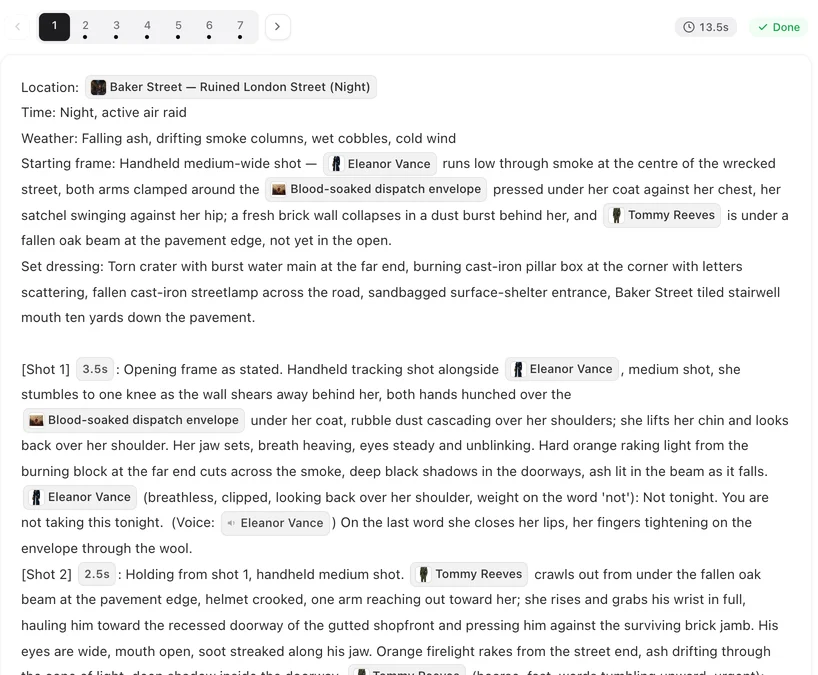
How to write it
Gaze: eyes toward frame right, looks straight into the lens, looks down and to the left. Address: speaks toward the door off-screen. Reaction: flinches from something at frame left. Movement: walks out of frame right. Left and right are the picture’s left and right, as the audience sees them. Keep the other person’s name for the shots they are actually in. How to Write One Shot.
What the site does for you
Before a clip is generated, names of characters who are not in the shot are replaced with direction words, and their sheets are not attached. The same for a character who exists only as a body or a corpse in that shot. It is a safety net: a shot written with names and later edited may slip past it, and directions you wrote yourself read better.
Two people who must share the frame
Side-on two-shot: both in profile or three-quarter, facing each other across the frame. Over-the-shoulder: one person’s shoulder in the near corner, the other’s face beyond it. Those are the two ways a camera can show two people facing each other. ‘A faces B, with B behind her in soft focus’ asks for A to face away from B and toward B at once; the model picks one and the staging breaks. Depth words (in the background, behind) are camera positions; use them only when the geometry works. Spatial Consistency.
Keeping sides consistent
Once A looks frame-left at B in one shot, B looks frame-right at A in the reverse. Keep that across the segment; swapping sides between shots reads as the two having changed places. The storyboard’s axis rule is written for this.
| Instead of | Write |
|---|---|
| Mei glares at Jun (Jun not in frame) | Mei glares toward frame left |
| He answers Father on the phone | He answers, eyes down, phone to his ear |
| She watches Jun leave | She watches something exit frame right |
| A faces B, B in the background | Over A's shoulder: B's face beyond it |
| The corpse of Wei at her feet | A body at her feet, face down |
FAQ
If the site fixes names anyway, why should I care?
The fix is a net, not a guarantee; and a direction tells the model where to look, which a removed name does not.
Can I name someone off-screen who is speaking?
Mark the line as off-screen; the speaker's name stays on the line, not in the picture text.
Which left is 'frame left'?
The audience's left, looking at the picture.
Why did a second face appear in a close-up?
Almost always a named off-screen character. Replace the name with a direction.
How do I show two people talking?
Side-on two-shot or over-the-shoulder; nothing else.
Updated September 27, 2026
Pricing·Novel to Video·Guides·Samples·Support·Privacy·Terms·Legal·Contact·© 2026 SceneMixer