How to Make an AI Revenge Drama

Brief for AI Create: A revenge drama: a wife pushed off a yacht by her husband and her best friend wakes up one year earlier, on the morning of her engagement; she lets them think nothing has changed while she takes the company back piece by piece; she exposes both at the anniversary party; cold, precise, satisfying.
How a revenge series is built
- The betrayal is the whole of episode 1. Do not explain it later. Show it: who did it, what they took, the moment she understood.
- The return. Either a second chance — she wakes up before it happened, with everything she knows — or a long absence and a new identity. Both give the lead an edge the villains do not know about.
- The list. Three to five targets, from the smallest to the one who planned it. Each target is an arc of a few episodes.
- The double game. The lead acts as if nothing has changed. Scenes where the audience knows more than the villains are the genre’s best tension.
- The public exposure. Each arc ends in front of witnesses: a party, a board meeting, a livestream, a wedding. Private revenge is not satisfying; humiliation needs an audience.
- No forgiveness until the end. If the lead softens, the series loses its spine. Let her soften once, late, and pay for it.
Rotate the episode endings: a villain getting closer to the truth, a new piece of evidence, an ally turning, a target falling. Hooks and cliffhangers.
Before and after: the lead’s two looks
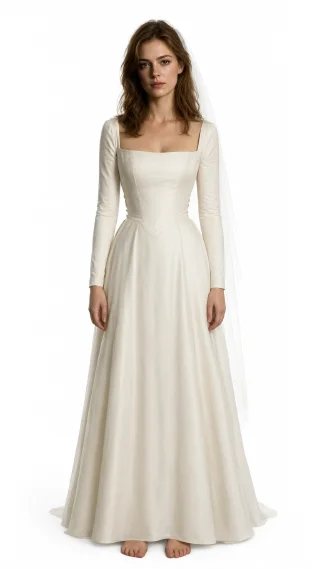
Rebirth and return stories usually show the lead in two versions: the trusting woman of the first life and the composed one who came back, or the plain student and the polished executive she becomes. If the difference is in her clothes, hair or face, it changes what the reference image shows, so it needs its own image:
- Generate her main image as the version who appears in most of the series.
- On her card choose Add a state, name it for the other version (First life, Before the fall), and describe only the difference: long loose hair, pale cardigan, no makeup, a hesitant posture.
- Press Generate this state, then, in the episode editor, select a segment set in the other life, open her from the episode’s assets and choose Use this state in this shot.
Pick flashback looks segment by segment, not for whole episodes. An episode that cuts between the past and the present would otherwise put her in the flashback clothes in every shot. If you never generate the state image, the shots describe the difference in words instead — weaker, but nothing breaks. Use a character state in one scene · Costume changes and states.


Settings to pick in step 1
- Type: Short Drama. Revenge depends on payoffs at a steady rate, which is exactly what the short-drama rhythm delivers.
- Aspect Ratio: 9:16 Portrait for feeds; faces and reactions are the payoff, and a vertical frame keeps them large.
- Visual Style: Realistic HD or Filmic Live-Action; Black & White Film is worth considering only if the whole series is a period piece.
- Scene Style: Urban Opulence or Corporate Cold for corporate revenge, Suburban Mansion for a family feud, Island Resort if the betrayal happens on a yacht or a holiday.
- Costume Style: Power Tailoring or Minimal Luxury; the lead’s transformation is better told through her state image than through a project-wide style.

Visual Style: Realistic HD

Visual Style: Filmic Live-Action

Scene Style: Urban Opulence

Scene Style: Corporate Cold

Scene Style: Island Resort

Costume Style: Minimal Luxury
Evidence that looks the same every time
Revenge plots run on objects: the recording, the second phone, the forged contract, the necklace that was never lost. The audience has to recognise the object the moment it reappears, so if your story keeps coming back to one, check that it has a card in step 2 with its own image, and name it with @ in every shot it is in. Two rules make evidence scenes work on screen:
- Show the object, say the content. A generated phone screen or document will not hold readable text. Let the line say what it proves; let the shot show who is holding it and who sees it.
- Cut to the guilty face. The reveal is not the object, it is the reaction. Give the villain a close-up with nothing else in frame.
Same prop in every hand · Text in the picture.
The exposure scene, written as shots
| Beat | Shot to adapt |
|---|---|
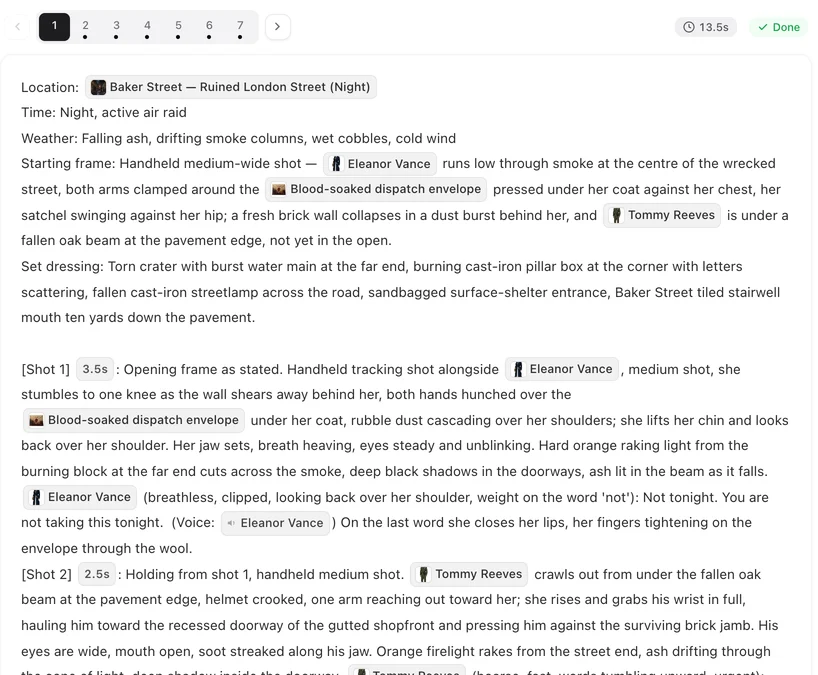
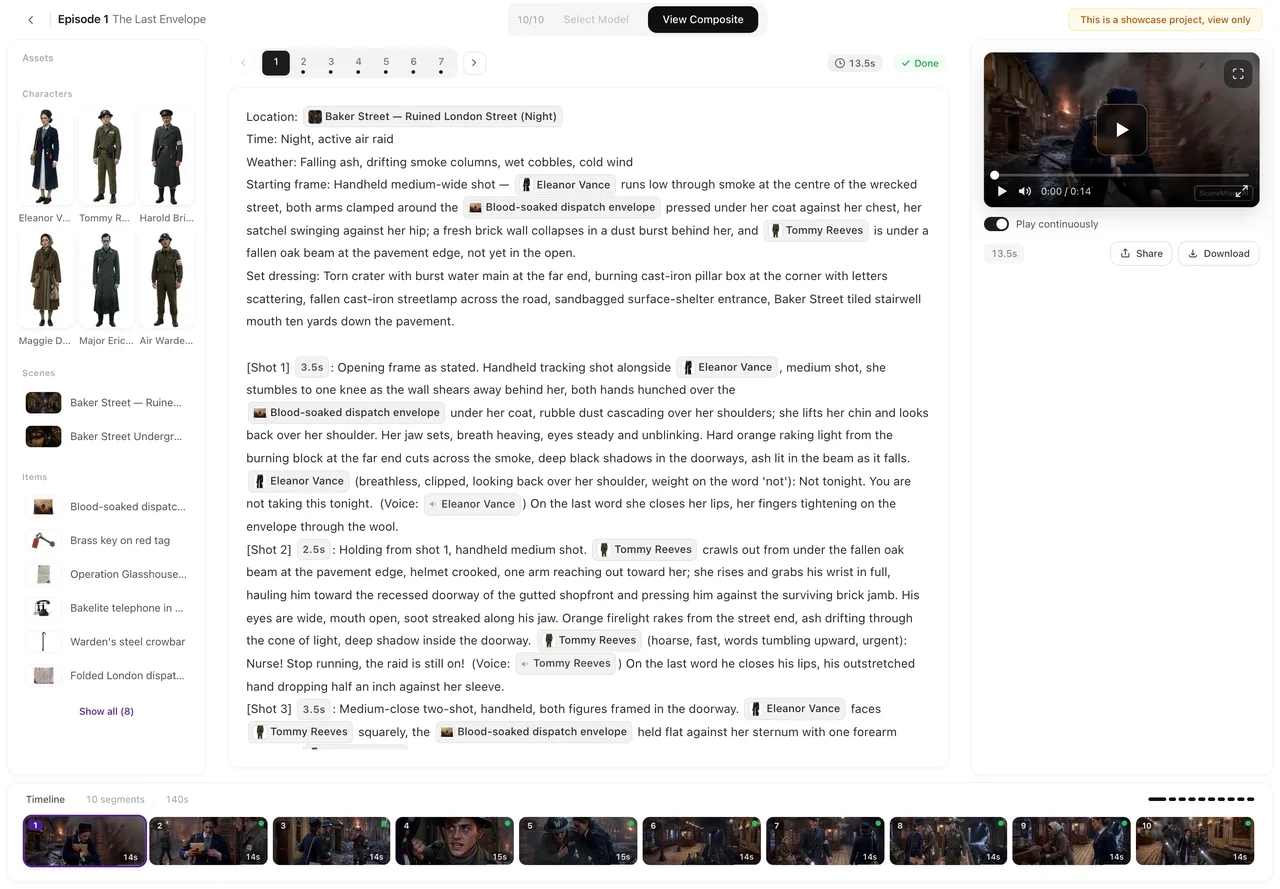
| The villain is comfortable | [Shot 1] 4s: Opening: medium shot. @Derek raises a glass at the head of the long table, @Claire at his side, smiling. @Derek (warm, loud): To the woman who made all this possible. Ambient: the murmur of a full room. |
| The lead moves | [Shot 2] 3s: Cut to close-up. In frame only: @Elena. She sets her glass down and stands. No dialogue. |
| The evidence | [Shot 3] 4s: Medium shot. @Elena holds up the @Second phone so the guests nearest her can see it. @Elena (calm): Then let’s play the part you left out. |
| The fall | [Shot 4] 3s: Close-up. In frame only: @Claire. The colour leaves her face; she looks at @Derek and he will not look back. No dialogue. Ambient: the room goes quiet. |
The guests are the segment’s background line, not characters. When the same two people share consecutive shots, change the framing between them so the join reads as a cut. How to write one shot · Background people.
Keep the revenge on the right side of the content check
Revenge plots flirt with violence: a push off a yacht, a car accident, a poisoning. The video is checked on every generation, and extreme violence and gore are blocked. Show the moment before and the consequence after: the hand on her back, then the water closing over; the brake pedal going to the floor, then the hospital corridor. Keep real people, real company names and real brands out entirely. Blocked by moderation: what to change.
Make it in SceneMixer, start to finish
- Script: paste your own on Upload Script or write a brief in AI Create that names the betrayal, the return, the list and the ending. Writing the one-line brief.
- Step 1: the settings above; read the script; check in the summary that each episode moves one target closer to their fall.
- Step 2: generate the cast and the places the story returns to; add the lead’s second look as a state; check the evidence props have images.
- Storyboard and video: episode 1 first. Its storyboard is free on your first project; video on the default tier is 10 credits a second.
- Fix, composite, post. Edits to storyboard text are free and every version is kept in the text history, so you can try a sharper line and go back if it reads worse. Storyboard text history.
For a second-chance story built this way, watch The Veil at Dawn: a woman wakes with memories of a past life and walks out on a toxic wedding.
| Arc | Target | Episodes | The takedown |
|---|---|---|---|
| 1 | The friend who helped | 2–5 | Her lies are read out at the engagement dinner |
| 2 | The family that looked away | 6–10 | They lose the share vote they took for granted |
| 3 | The husband’s partner | 11–15 | The deal he built on stolen work collapses on a live call |
| 4 | The husband | 16–20 | Exposed at the anniversary party, in front of everyone he lied to |
FAQ
How do I show a flashback to the lead's first life?
Give her the first-life look as a state of her character, then pick that state only in the segments set in the past. Picking it for the whole episode would put the flashback look in every shot.
Can AI Create write a rebirth revenge story?
Yes. Name the betrayal, how she comes back, who she wants to take down, the ending and the tone in one or two sentences, then pick a length.
How many episodes does a revenge drama need?
One arc per target is a good unit: a few episodes each. Three or four targets make a full season. Publish the first arc before writing the rest.
Can the villain be a real company or a real person?
No. Real people are not allowed, brand names and logos trigger the IP check, and real companies do not belong in a story about crimes. Invent them.
How do I show a crime without the video being blocked?
Show the moment before and the result after, not the act itself. A hand on her back and then the water is clearer on screen than the fall.
Can the evidence be a readable document or text message?
Keep the reading in the dialogue. Generated screens and paper do not hold reliable text; show who holds it and how the guilty party reacts.
Can I switch to vertical after I have started?
No. The aspect ratio is fixed once you continue past step 1. Start a new project with the same script for the other format.
Does a revenge drama cost more to make than a romance?
No. Every genre is priced the same way: the read, the setup images, the storyboard and the video by the second.
Write the betrayal. Then the list.
Start with one sentence in AI Create, or paste the script you have.
Updated October 13, 2026
Pricing·Novel to Video·Guides·Samples·Support·Privacy·Terms·Legal·Contact·Affiliate program·© 2026 SceneMixer