Answers · Process
How Are AI Videos Made?
Published November 17, 2026

Why people keep asking
A convincing AI video can look impossible to someone who has only seen still images generated. One viewer wrote, after being told a clip they admired was AI:
I saw some people saying it's ai but I'm unable to comprehend how this is made using our current ai capabilities
That came from a post titled with the question in r/generativeAI. The craft side of the answer is a large subject in its own right: prompts and camera direction account for about 22,000 posts in the community corpus. The short version is that there are two layers — what the model does, and what is done around it.
Inside the model: from noise to frames
Most current video models learn from very large amounts of footage paired with descriptions. To generate, they begin with random noise and refine it over many steps, each step nudging the frames closer to something that fits the description and any reference images supplied. The output is a short clip, usually a few seconds to fifteen or thirty, because keeping every frame consistent gets harder the longer the clip runs. Reference images narrow the guesswork: given a picture of a character, the model draws that person rather than inventing a new one that merely fits the words. On current models, sound — footsteps, rain, a character speaking a line — is generated in the same pass rather than added afterwards.
That is also why a model alone struggles with a story. It sees one request at a time. It does not remember that the detective wore a grey coat in the last clip unless the next request shows it the coat.
Step one: the words
A story starts as a script, a chapter or one line. On SceneMixer the text is read into characters, places, props and episodes, each episode with an outline. This is the cheapest step and the one that decides the most.
Step two: the references
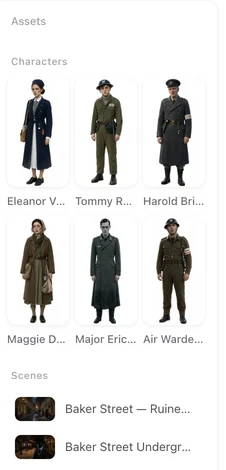
Each character gets a full-body reference sheet and each place an image, drawn in the visual style chosen at the start. These are the memory the model lacks: face and body crops from a sheet are attached to every segment that character appears in.
Step three: the shots in text
Every episode is written as a storyboard: location, time, the starting frame, then numbered shots with their seconds, the camera, the action and the spoken line. Editing this text calls no model and costs nothing, so most of the directing happens here. A shot that reads clearly — one place, one action, a camera that does one thing — is a shot the model can draw; How to write one shot shows the habits that make a written shot reliable, from the starting frame to the length of a line.
Step four: segments with sound
A few shots in one place are generated together as a segment, with the right reference images attached, and the segment comes out with its sound already in it. The next segment opens where the last one ended, so a movement carries across the cut. A segment that misses is fixed by changing its words and regenerating it alone.
Step five: the join and the finish
Segments are joined into one episode, at 1 credit a second of the finished length, with an automatic score you can switch off. A finished clip can be raised one resolution step at a time with Enhance, up to 2K, and the file carries a small AI badge and a metadata tag on free accounts. Measured on SceneMixer over the 30 days to November 6, 2026, a whole episode was typically ready 24 minutes after its first segment started.
Limitations of how AI video is made
- The footage is invented, not recorded; nothing in it happened.
- Results vary from one generation to the next, so plan for an occasional retake.
- Lettering in the picture is unreliable, so titles go on afterwards.
- Consistency depends on references; a shot described from scratch can still drift.
- The episode time is a one-month median from one site, and the topic count is a rule-based estimate.
FAQ
How are AI movies made?
The same way, at greater length: a screenplay, reference sheets for the cast, a shot-by-shot storyboard, many segments, and a join. SceneMixer's Film type removes the episode cap.
Do AI videos use real footage?
No. Generated footage is new; reference images guide it, but no recorded video of the scene exists.
How long does it take to make an AI video?
Rendering takes minutes per segment, and segments run side by side; the writing and checking take longer than the generating.
What do I need to make an AI video?
An idea or a script, a look, and a cast drawn once. A computer and a browser are enough; no camera or graphics card.
How does AI video work?
A video model turns a text description, often with reference images, into a few seconds of moving picture. Longer videos are planned as many such shots and joined; SceneMixer adds the script, cast and storyboard steps around the model.
Related: what AI video is, what it can and cannot do yet, and the collection method behind the topic count.
Follow the steps on your own story
Words, references, shots, segments, join. See each step before paying for the next.
Sign up freePer-second video rates are on the pricing page with the same numbers.