Describe the Cause, Not the Result: The One Rule Behind Good Sheets and Good Shots

Take one of your character descriptions and strike every word that judges (beautiful, imposing, cinematic); what is left should still describe a person.
The rule in one line
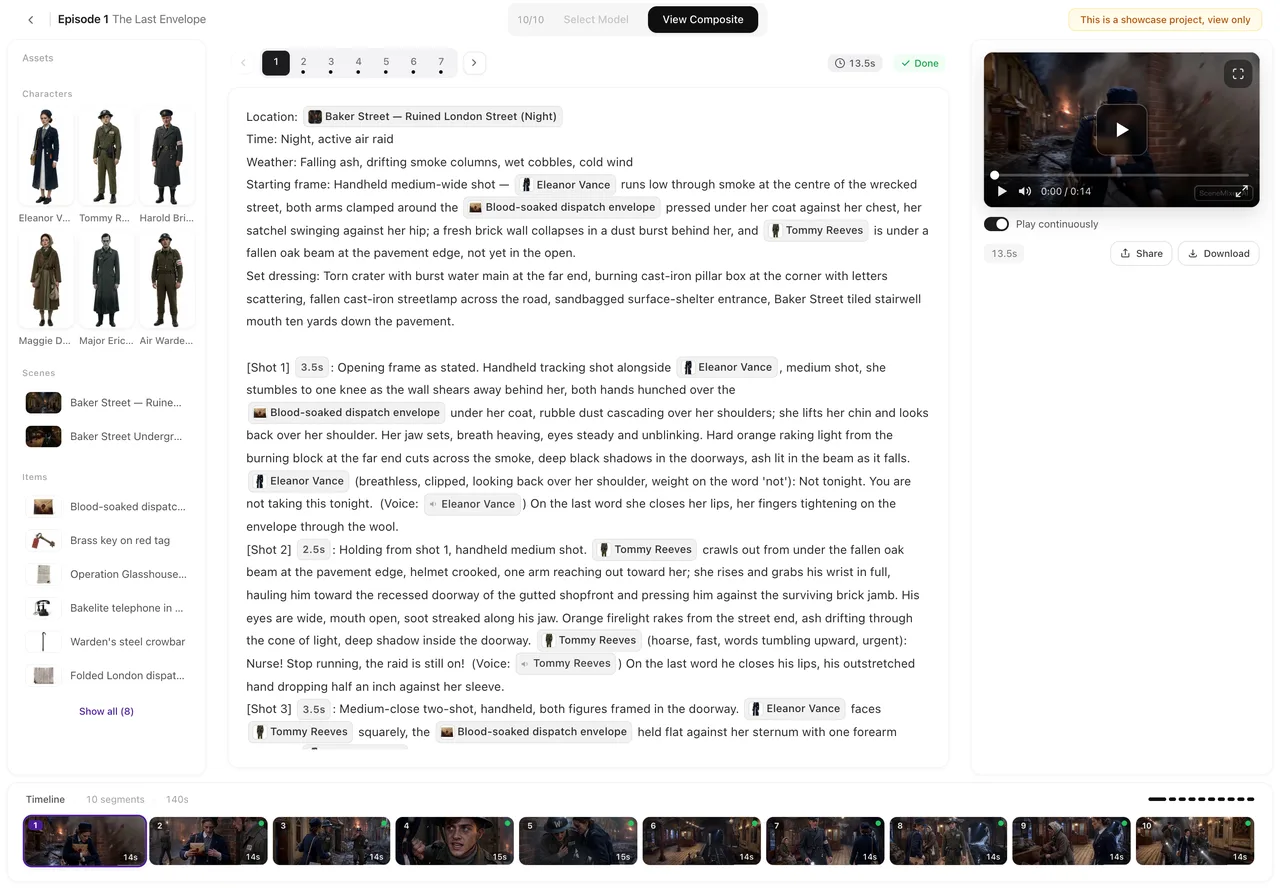
A description is not a review of the picture you want; it is an inventory of what is in front of the camera and where the light comes from. Everything else — glow, shadow, mood, drama — is a consequence the model computes. Name the cause, get the consequence; name the consequence, get a literal painting of it.
Light: place the lamp, never the highlight
“Warm light on her forehead and nose” produces a smear of yellow on the forehead and nose, precisely where you said, like a torch held to the face. “A warm ceiling lamp above and to the right, a window to the left” produces a lit face with a shadow side and a rim of daylight, because that is what such lamps do. Two extra habits: do not name a boundary (“where the two colours meet on her nose” draws a hard line), and avoid saturated colour words for light — a tungsten lamp on skin is warm white, and “yellow” gets you yellow paint.
Faces: features, not verdicts
“Strikingly beautiful”, “handsome”, “fierce” are verdicts; the model resolves them to an average pretty face and the character loses her identity. Write the bones: eye shape, brow, nose bridge, jaw, a mole, a scar, the way the hair falls. Then one or two things she does with the face: eyes narrowed, mouth set. Identity survives because it was described, not requested. Write a Description That Works.
Rooms and objects: material and layout, not atmosphere
“A gloomy, oppressive corridor” gives you a dark smudge. “A hospital corridor, green tiles to waist height, fluorescent tubes every three metres, one flickering, doors on the left” gives you a corridor that is gloomy because of what is in it, and it will be the same corridor in every shot. Props the same way: “a worn leather satchel, brass buckle, strap repaired with tape”, not “an important-looking bag”.
Shots: actions from a starting posture, directions in frame terms
In the storyboard, an action needs a starting state and a direction: “seated, she stands and turns toward frame left” rather than “she reacts dramatically”. Someone outside the frame is a direction (“looks toward frame right”), not a name. “Tension”, “energy” and “a powerful moment” describe nothing the camera can see and are ignored or painted as noise. How to Write One Shot.
| Result (avoid) | Cause (write this) |
|---|---|
| Warm light on her forehead and nose | A warm ceiling lamp above and to the right; window light from the left |
| An air of menace | Scar through the left eyebrow, eyes narrowed, jaw set |
| A gloomy corridor | Green tiles to waist height, fluorescent tubes every three metres, one flickering |
| Volumetric god rays | A layer of cigarette smoke hanging in the room; one small window |
| She reacts dramatically | Seated; she stands and turns toward frame left |
FAQ
Is this only for sheets, or for the storyboard too?
Both. Sheets are drawn from descriptions; shots are drawn from the storyboard text. The same rule applies to both.
Can I say 'cinematic' at all?
It adds nothing the model can place in the frame. Say what makes it cinematic: the lens, the light, the framing.
What about the visual style preset?
That is where the look lives: live action, anime, 3D. Descriptions should not repeat it.
Why do my sheets come out with a yellow face?
Almost always a lighting result written in the description. Move the lamp instead.
Does the rule apply in Chinese and English alike?
Yes; the models read both, and verdict words fail the same way in both.
Put the lamp in the room
Describe what is there and where the light comes from; let the model do the lighting.
Updated September 27, 2026
Pricing·Novel to Video·Guides·Samples·Support·Privacy·Terms·Legal·Contact·© 2026 SceneMixer